SI LLMs for GLAM

Education

From Keyword to Conversation: What LLMs Change (and Don’t) About Library Discovery in Ghana’s Colleges of Education

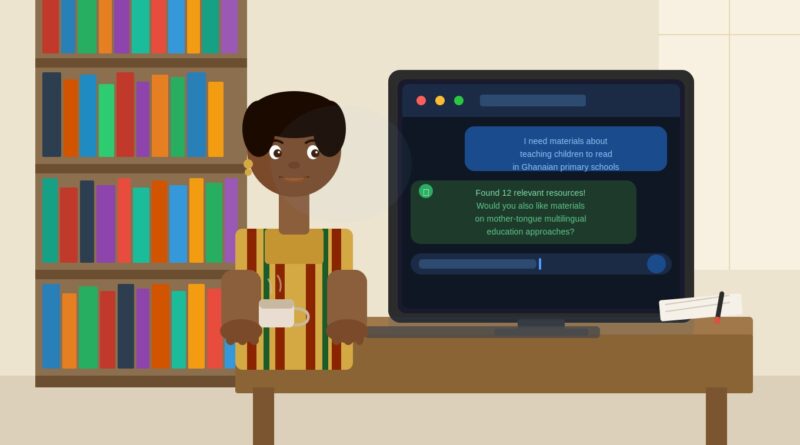
Picture a student-teacher at a College of Education in Ghana, preparing a lesson on early childhood literacy. She approaches the library catalogue terminal, types a few keywords, “early childhood reading Ghana”, and receives a handful of results, most of them older texts with limited relevance to the Ghanaian classroom. She leaves with less than she came for. Now imagine the same student interacting with a library interface powered by a large language model: she types, in her own words, “I need materials about teaching children to read in Ghanaian primary schools.” The system responds conversationally, surfaces related resources, and asks whether she would like materials that address mother-tongue-based multilingual education. Something has clearly shifted. But as a college librarian in Ghana, I find myself asking: how deep does that shift really go and for whom?

Read More


Translation

Can AI Describe Art as We Do? A Case Study on a Pottery Collection

There are two capabilities of current large language models (LLM)-based AI systems that we attempt to evaluate for improving the discoverability of library and museum collections, which are often searched by using expert-defined keyword vocabularies through complex hierarchical categories: 1) Vector search: differing from the traditional keyword search, it improves discovery of word semantic relationships in a broader natural language domain and 2) Multimodal large language models (MLLM):  combining computer vision processing images alongside LLMs, boosting understanding of the image both textually and visually. We explore how visual language models (VLM) and MLLMs can bridge vocabulary gaps in search between expert-generated descriptions and the public.

Read More
Opinion

When Search Starts Answering: What Libraries Need to Explain About AI

Library search tools aren’t just returning results anymore. They now summarize, suggest, and sometimes even interpret information for us. Search tools once helped users find materials. Now they are beginning to offer answer-like interpretations of what a collection appears to mean. Sure, it feels helpful. But it also quietly changes how people decide what is credible, what is complete, and what feels neutral. Before libraries ask people to trust AI-mediated discovery, they need to explain what the system is doing on the user’s behalf.

Read More
Translation

Beyond the Boolean: Is Natural Language search opening or closing the discovery gap for university e-library users?

For decades, the “search box” at the heart of the university library has been a gatekeeper. To unlock the vast treasures of academic databases, users had to speak a specific, rigid language, Boolean. For expert researchers, terms like AND, OR, and NOT are second nature. But for many students without appropriate information searching skills and training, the traditional search interface has often acted more as a barrier than a bridge.

Read More