

Introduction to the Special Issue on the Power of Information in Marginalised Communities
This special issue of Information Matters explores the crucial role of information in empowering and transforming communities facing systemic challenges and in redressing systemic inequalities. The eight articles in this special issue discuss different ways in which these objectives can be achieved.

Transforming Ourselves, Transforming Inequity: Reimagining Partnerships for Information Justice
Thinking of communities as “information poor” misrepresents the reality of systemic exclusion. Instead, marginalized communities have been intentionally and unintentionally excluded from mainstream information infrastructures. This exclusion is not due to a lack of knowledge on the part of marginalized communities but rather a reflection of structural barriers that limit access to institutionalized information flows. We need to recognize the existence and prevalence of information precarity, and then we need to radically alter how we plan and carry out projects, research, and outreach with—not for—marginalized communities.

Gatekeeping Reproductive Rights: Why SRHR Information Matters for Youth
How can sexual and reproductive justice be achieved in communities where youth struggle to access Sexual and Reproductive Health and Rights (SRHR) services? When young people receive accurate, stigma-free SRHR information, they make informed choices, improve their well-being, and advocate for their rights.

Local Adaptation to Climate Change: Scope for MFIs in Bangladesh
Microfinance institutions (MFIs) possess a unique and powerful tool for combating the localized challenges of climate change: the social capital of their borrowers. While MFIs rightly prioritize poverty reduction, they can and should simultaneously leverage this inherent social capital to address the growing threat of climate change.

Understanding Cyberbullying targeting women in Bangladesh from complex social-ecological lens
Our analysis raises critical questions: Why do segments of the general public express such hostility towards women in digital spaces? Are these sentiments a mere reflection of broader societal attitudes, or are they amplified by the affordances of online anonymity and lack of accountability? What structural interventions are necessary to dismantle these patterns of digital violence? Understanding these underlying factors is imperative to formulating sustainable strategies to combat cyberbullying.
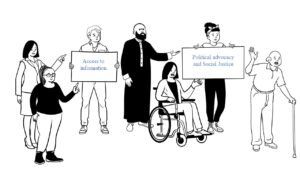
Political Advocacy and Social Justice through Information for Marginalised Communities
We are currently living in an information-driven world; despite this, many people are still devoid of access to information. Through impartial access to information, society can empower individuals to navigate the complexities of the information age better, enhancing their capacity to participate in and benefit from political discourse, social activities, and economic opportunities. This article will explore how marginalised communities can effectively connect in the political advocacy and social justice through improved access to information.

Roots to Routes: Community Resilience through Ancestral Knowledge
In a world where progress and innovation are often prioritised, I highlight the need to reconnect with the past, drawing on the wisdom passed down through generations. Mnemohistory, which focuses on how societies remember and reinterpret their history, shows that communities don’t just preserve events but also pass on cultural practices, stories, and shared experiences that shape their identities, and by tracing developmental paths through this historical knowledge, we can see how communities use their past to deal with present challenges and plan for the future.

How Information Objects Can Create Information Inequity
Information plays an important role in helping people make informed decisions and advocate for themselves socially, economically, and politically. However, not everyone has fair or equitable access to information. Information science scholars term this information inequity—the individual and societal factors that limit an individual, group, or nation’s access to information. Addressing information inequities by identifying and rectifying their causes is essential to helping all people fully participate in our society and democratic system.

Exploring Women’s Health Information Literacy with AI: A South Asian Study
The relationship between AI and people’s health information is increasingly significant, and AI chatbot provides significantly more accurate answers to patients. However, while technology can help, it is up to people to decide how they want to use it. Even an AI tool like ChatGPT says “ChatGPT can make mistakes. Consider checking important information.” Using AI tools to make health-related decisions requires a good understanding of the information these tools provide. The project “AI and Health Information Literacy: A study exploring the perceived usefulness, and readiness among women in South Asia” aims to address the questions like “How do women in South Asia (SA) perceive the usefulness of AI in enhancing health information literacy?” and “What factors influence their readiness to adopt AI-driven health information technologies?”