
What Happens When Research Starts with an Answer?
For decades, information literacy has focused on helping people find, evaluate, and use trustworthy information. The Association of College and Research Libraries’ Framework for Information Literacy for Higher Education reminds us that searching is more than entering keywords into a search box; it is a process of exploration and inquiry. Students refine questions, compare sources, encounter competing perspectives, and gradually build understanding. Research has never been simply about locating information—it has been about learning through the search process itself. Generative AI changes where that process begins. Rather than gathering evidence before reaching a conclusion, students often encounter a synthesized explanation before they know who created it, what evidence supports it, or what perspectives may be missing. As Leo Lo has observed, we are moving from “search first” to “answer first.” Research still depends on searching, evaluating sources, and building understanding, but AI has changed the sequence. Students increasingly begin with an answer and must work backward—finding evidence, evaluating it, and ultimately making sense of it. If research now starts with an answer, information literacy must evolve to prepare learners for that new reality.
At first glance, getting an instant answer seems like a tremendous advantage. Generative AI lowers the barrier to getting started. Students unfamiliar with a topic can receive a plain-language explanation in seconds, brainstorm ideas, ask follow-up questions, or review concepts before an exam. These benefits are real and should not be dismissed. Yet beginning with an answer changes more than the research process—it changes how people learn. Traditional searching requires students to choose keywords, revise searches, compare sources, weigh conflicting viewpoints, and determine which evidence is most convincing. Those decisions are not obstacles; they are part of the learning process because students construct understanding as they search. Generative AI compresses much of that work into a polished response. The cognitive work has not disappeared—it has shifted. Instead of asking, “Which sources should I trust?” students increasingly ask, “Can I trust this answer?” Answering that question requires more than accepting or rejecting AI’s response. It requires tracing the answer to its evidence, evaluating the sources behind it, and deciding what the evidence actually means.
I first recognized this shift when I redesigned one of my information literacy sessions around AI. Last semester, I gave students a list of citations generated by ChatGPT and asked them to determine which ones actually existed. At first, many assumed every citation was authentic because the author names, article titles, journal names, and publication dates looked convincing. When they searched library databases and Google Scholar, however, they discovered that some citations were fabricated or contained inaccurate details. The lesson was not that AI makes mistakes—students already know that. It was that information should not be trusted simply because it appears authoritative. Every claim, even one presented confidently by AI, must be traced back to reliable evidence. That experience also reshaped how I think about my role as a librarian. Increasingly, my work is less about showing students where to search and more about helping them ask better questions about the answers they already have. Where did this information come from? Can I verify the evidence? What happens when I trace this answer back to its sources? How does that evidence change my understanding of the topic?
Those questions led me to realize that information literacy in the AI era requires something broader than traditional source evaluation. Source evaluation asks whether information is trustworthy by examining its author, evidence, methodology, and potential bias. Those questions remain essential, but they are no longer sufficient when students begin with AI-generated answers. Unlike a search engine, which primarily retrieves information, generative AI typically presents a synthesized interpretation before users ever encounter the underlying evidence. In traditional research, students performed the intellectual work of synthesizing multiple sources into their own understanding. With AI, much of that synthesis has already been done for them. The challenge is no longer simply determining whether information is trustworthy; it is deciding whether that interpretation is supported by evidence and what it ultimately means.
This is where sensemaking becomes essential. Searching helps us locate evidence. Source evaluation helps us determine whether that evidence is trustworthy. Sensemaking brings those skills together by asking what the evidence actually means. Rather than replacing searching or source evaluation, sensemaking builds on them. It is the process of examining an AI-generated interpretation, tracing it back to its sources, recognizing missing perspectives, reconciling conflicting information, and deciding what conclusions the evidence truly supports. AI can provide a valuable starting point, but it cannot determine how competing evidence should be weighed or how our understanding should change when new information emerges. Those remain fundamentally human responsibilities.
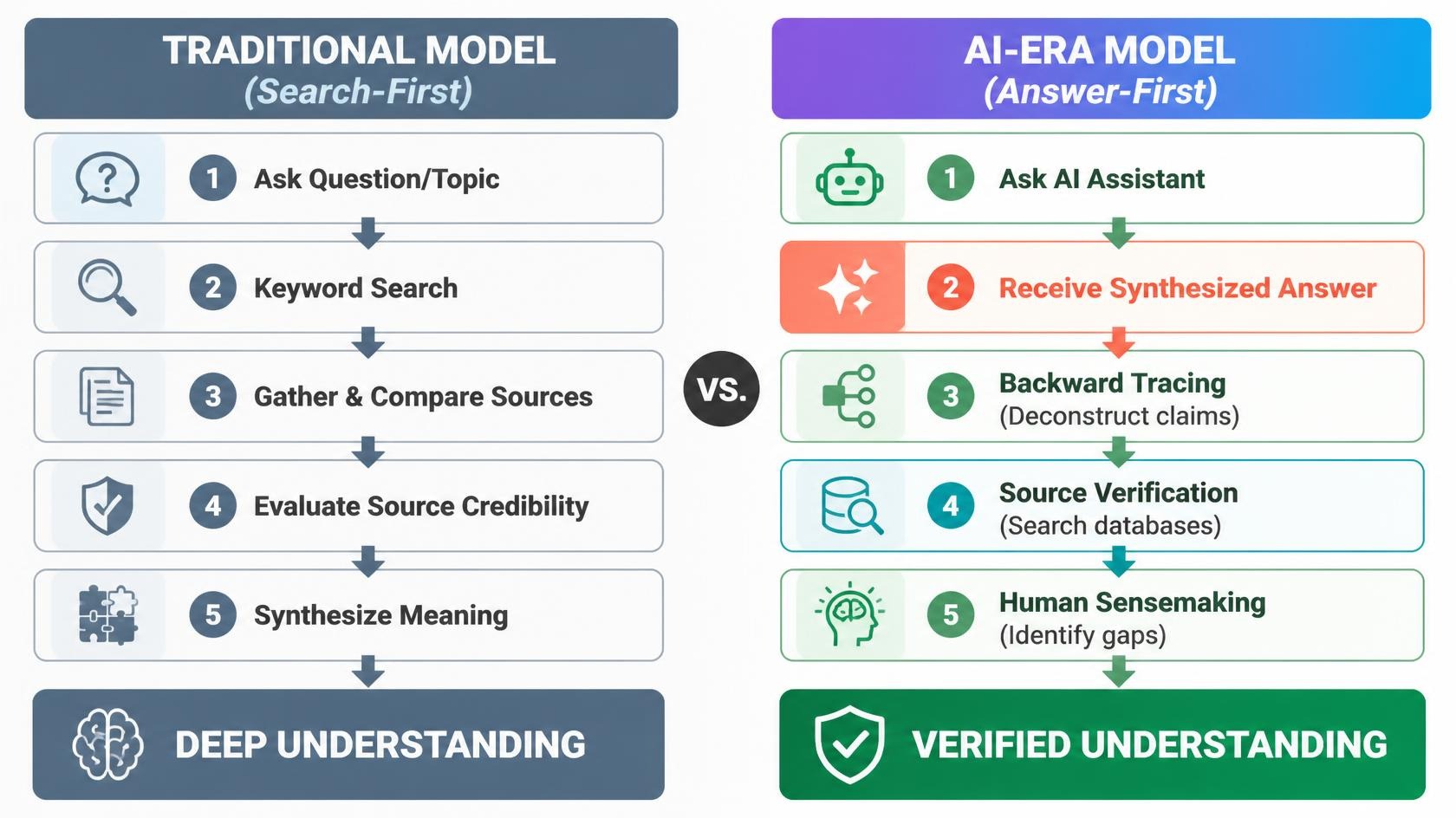
This shift extends far beyond higher education. People increasingly rely on AI to understand medical conditions, evaluate financial decisions, interpret workplace policies, and make sense of political events. As generative AI becomes a common gateway to information, the habits traditionally associated with information literacy become essential life skills. We must be able to trace claims to evidence, evaluate the credibility of sources, recognize uncertainty, identify missing perspectives, and revise our understanding when better evidence becomes available. Libraries have never been simply about helping people find information; their deeper mission has always been helping people understand it. That mission has not changed, even if the tools have. What generative AI changes is where the process begins. The next time you ask an AI assistant a question, the most important question may not be whether its answer is correct. It may be what you do next. Do you simply accept it, or do you question it, verify it, test it against evidence, and refine your understanding? Research may now begin with an answer, but understanding still begins with questions.