EditorialFeatured

Dancing Robots Don’t Impress Me. Show Me the Laundry.

Dancing Robots Don’t Impress Me. Show Me the Laundry.

Chirag Shah, University of Washington

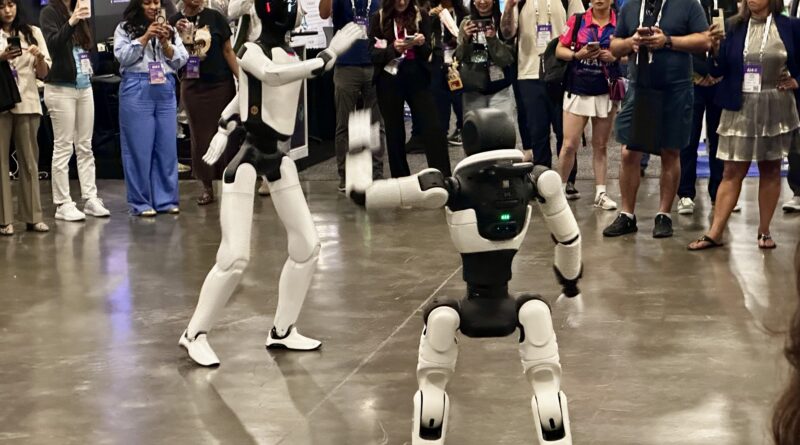
If you have been to any AI event or trade show in the past few years, you have probably seen a familiar sight. Humanoid robots being paraded around, walking, shaking hands, and dancing. I have seen plenty of them. Wrestling, dancing, playing soccer. Crowds gather around like they are witnessing a total solar eclipse.

It’s understandable. We are fascinated by things that move and act the way we do. That’s why we dress up our pets as pirates for Halloween. That’s why we picture gods in human form. That’s why we fantasize about robots looking like us, even though two legs and an upright spine are a mediocre engineering choice that gives most of us back pain by forty. The fascination even extends to the villains. Thanos (yes, Avengers reference!) is an alien, and yet he looks like a very large, very purple man. So do the Terminators. If your job is to hunt or protect humans, you could take any number of more suitable forms, but we insist that our heroes, villains, and gods show up with a face.
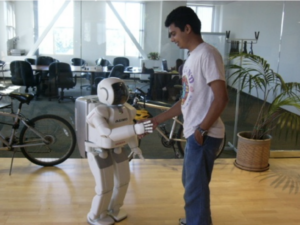
I understand all of that. I have written about it, and I write about it again in my upcoming book Raising AI. In fact, years ago I even worked on Honda’s humanoid ASIMO (yes, that’s my younger self shaking hands with astronaut-looking ASIMO in that picture!).

What I don’t understand is being so impressed by the dancing. It’s a genuine achievement in mechanics, control, and sensing, and the engineers deserve their applause. But I keep asking what problem it solves. If you want to impress me, show me one of these robots doing my laundry.


—If you want to impress me, show me one of these robots doing my laundry—

The towel is harder than the backflip

I’m not being flippant. A backflip is a hard problem in a solved environment. The floor is flat, the lighting is fixed, the routine is rehearsed, and someone has swept the stage. Laundry is the opposite. A crumpled towel has no canonical shape. A fitted sheet is a topological insult. My kids’ socks come out of the dryer inside out, tangled with a hoodie string, and one of them is inexplicably damp.

Roboticists have known this for decades. It’s Moravec’s paradox: the things that feel effortless to a two-year-old, like grabbing a soft object in a cluttered room, are brutally hard for machines, while the things that feel hard to us, like optimization and calculation, are easy. Choreography sits on the easy side of that line. Household mess sits on the hard side. When the DARPA Robotics Challenge asked humanoids to open a door and turn a valve, the highlight reel was mostly robots falling over. That reel taught us more than any dance ever has.

So when a demo goes viral, the honest question isn’t “what can it do?” It’s “what was removed from the room so it could do that?” Rodney Brooks, who has spent a career building robots that actually ship, has been making this point for years while everyone else films the stage.

The Terminator is the same distraction wearing a leather jacket

Here is what I find funny. The people cheering the dancing robot and the people warning about the killer robot think they are on opposite sides. They are running the same script. Both have decided that the future arrives in a human-shaped body, and both are watching the body instead of the system.

Our doom stories have the same flaw as our demo reels. They are staged. Skynet becomes self-aware at a specific hour, announces itself, and starts shooting. It’s clean, it’s cinematic, and it’s the wrong shape of worry. Real harm from AI has been arriving without a face, without an announcement, and without anyone identifiable to blame.

Where it actually helps, and where it actually hurts

The useful robots are boring. They move pallets in warehouses, weld car frames, inspect pipelines and wind turbines, hold a camera steady during surgery, pull weeds between crop rows, and go into places that would kill a person. None of them has a face. Almost none of them walks. Most of them are, in the least glamorous sense of the word, appliances. The same is true on the software side, where the wins look like a claim processed in an hour instead of six weeks, or a radiologist catching something on a second pass.

The damage is equally faceless. In the Netherlands, an algorithm used to flag childcare benefit fraud wrecked thousands of families and eventually brought down a government. No robot uprising, just a risk model, a bureaucracy that trusted it, and years before anyone with authority admitted what had happened. Résumé screeners quietly reject people who never learn they were screened. Warehouse productivity systems set the pace of a human body and call it optimization. And a chatbot can become the entity a struggling teenager confides in at 2 a.m., which is a failure with many authors and, conveniently, no defendant.

Notice what all of these have in common. Somebody delegated a decision to a system, the system acted, and when it went wrong, nobody could say whose call it was. I’ve come to call this the delegation paradox, and it’s the thread running through my work on agentic AI. The more capable our systems get, the more we hand over. The more we hand over, the harder it becomes to locate the human who is answerable. That’s the actual risk, and it doesn’t photograph well.

A better test than the dance floor

The next time a demo makes a room go quiet, try asking four questions. What was taken out of the environment to make this work? Who is the specific person harmed if it fails at scale? Who has authority to overrule it, and can they do so in under a minute? And if this succeeds completely, whose day gets better, and whose gets measured more tightly?

None of those questions are hostile to progress. I want the robots. I want the agents. I just want us spending our attention where the consequences live, which is in warehouses, clinics, benefit offices, and my kids’ phones, not on a stage with good lighting.

So dance if you want. I’ll clap politely. But I’ll save the standing ovation for the machine that walks into my house, opens the dryer, finds the second sock, and folds the fitted sheet. Then I’ll want to know who’s responsible if it shrinks my favorite shirt.

Cite this article in APA as: Shah, C. (2026). Dancing robots don’t impress me. Show Me the Laundry. Information Matters. https://informationmatters.org/2026/08/dancing-robots-dont-impress-me-show-me-the-laundry/

Author

  • Chirag Shah

    Dr. Chirag Shah is a Professor in Information School, an Adjunct Professor in Paul G. Allen School of Computer Science & Engineering, and an Adjunct Professor in Human Centered Design & Engineering (HCDE) at University of Washington (UW). He is the Founding Director of InfoSeeking Lab and the Founding Co-Director of RAISE, a Center for Responsible AI. He is also the Founding Editor-in-Chief of Information Matters.

    His research revolves around intelligent systems. On one hand, he is trying to make search and recommendation systems smart, proactive, and integrated. On the other hand, he is investigating how such systems can be made fair, transparent, and ethical. The former area is Search/Recommendation and the latter falls under Responsible AI. They both create interesting synergy, resulting in Human-Centered ML/AI.

    View all posts

Chirag Shah

Dr. Chirag Shah is a Professor in Information School, an Adjunct Professor in Paul G. Allen School of Computer Science & Engineering, and an Adjunct Professor in Human Centered Design & Engineering (HCDE) at University of Washington (UW). He is the Founding Director of InfoSeeking Lab and the Founding Co-Director of RAISE, a Center for Responsible AI. He is also the Founding Editor-in-Chief of Information Matters. His research revolves around intelligent systems. On one hand, he is trying to make search and recommendation systems smart, proactive, and integrated. On the other hand, he is investigating how such systems can be made fair, transparent, and ethical. The former area is Search/Recommendation and the latter falls under Responsible AI. They both create interesting synergy, resulting in Human-Centered ML/AI.

Leave a Reply