Education

Education

The Race to Publish, Publication Pressures, and Questionable Practices: Rethinking the System

In today’s academia, the lines between the identity of a researcher devoted to following the trail of knowledge and the identity of a performance-driven academic focused solely on producing publications are increasingly blurred. For many scholars, publishing is no longer just a contribution to science but a mandatory step for climbing the academic career ladder. This is not a matter of individual choice, it is deeply structural. Evaluation systems that reward where research is published rather than the quality of the process itself are a major driver of this shift.

Read More
EducationOriginal

Fear, Concern, and Collapse of Artificial Intelligence Tools: Perspectives of an Academia

Technology is not a bad invention, but the inability to be human after its adoption and use is what is challenging human existence. Young adults see technology as demi-gods and adore AI without employing critical thinking. Despite their digital nativeness, there is a lack of skills to critically interrogate AI tools and decipher their output or results. Many young adults do not know that AI is prone to error, stemming from the large language models (LLM) upon which it operates. Therefore, there is a greater need for critical digital literacy skills — now more than ever.

Read More
EducationOriginal

Ensuring Human-Centered AI EdTech: Inclusive Design and Evolving Information, Digital, Media, and Algorithmic Literacies

Emerging technologies increasingly impact the design of and access to education. Current research in higher education and educational technology argues the benefits (e.g., time-saving, personalization, scalability) and concerns (e.g., academic integrity, accessibility, data reliability, ethics, privacy) of students using artificial intelligence in education. Though these pro and con lists may be valid and growing, a perspective is often missing from conversations about AI in education: accessibility and people with disabilities. This article first reviews the importance of understanding relevant literacies—information, digital, media, and algorithmic—and describes examples of educational technologies (EdTech) that highlight learning objectives of using and creating knowledge and content with those tools. Then, inclusive and human-centered design principles are discussed as a foundational construct to design human-centered AI and use cases for integrating AI in learning design.

Read More
Education

Information and You: McGill’s Perspectives on Human-Information Interaction Research

From cybersecurity to archives, and everything in between, research at the McGill University School of Information Studies centers around human-information interaction (HII) – putting people, their experiences, their needs, and their priorities at the heart of the research. These vignettes highlight some of the research from SIS faculty, and how it connects people with the information that matters to them.

Read More
Education

Colonial Tensions: Reconciling Intellectual Freedom and Indigenous Knowledge Systems in One Canadian iSchool

How do we further the enormous task of truth and reconciliation between the fundamental principle of intellectual freedom with the collective sovereignty due to our First Nations siblings? This is a recurring question and theme of the course Foundations of Intellectual Freedom in Librarianship at the iSchool of the University of British Columbia. In the winter of 2023, I was tasked with the development of a dedicated course on intellectual freedom. It is currently one of only three such courses in Canada, alongside the University of Alberta and the University of Toronto.

Read More
Education

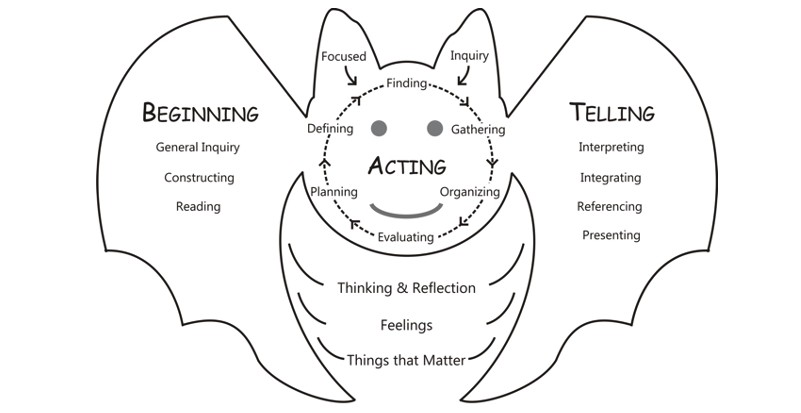
Stepping Up to BAT: Inspiration for a Research Process Model

Wouldn’t it be great that at the same time you were learning to read chapter books and basic informational texts, you could learn a research process that could carry you right through post-secondary studies? As M. E. Marland, a member of the UK Schools Council, asserted in 1981, from elementary school to PhD studies, in research, the questions and processes remain fundamentally the same. To find out if that was true for the Canadian context, for my PhD dissertation study I decided to observe the information behaviours of grade-three students as they worked on a class project.

Read More
EducationProfessional Development

Building Capacity for Decision Making Where Information Matters

As educators, we believe we have a responsibility to equip students entering professional careers with the knowledge and skills to consider evidence critically, to understand the roles of various actors who could and should be included in decision processes, and how to arrive at solutions to societal problems effectively. Accordingly, for over a decade we have offered a graduate course, Information in Public Policy and Decision Making, in the Dalhousie University Master of Information program. Unique among the Canadian Information Studies programs, this course is designed to introduce students to the many facets of evidence-based (or evidence-informed) policy and decision-making with the expectation that as the next generation professionals they will understand when and how to facilitate policy development at organizational and local, national, and international levels.

Read More
Education

Tracing “CanCon” in Library and Information Science Research

LIS professionals and practitioners may find it challenging to access current research that supports library decision-making, program development, or service evaluation through a distinctly Canadian lens. Public, school, and special libraries did not seem to have the same kind of representation in the research, and it made me wonder: what is the state of Canadian LIS research content?

Read More