
Beyond the Obvious: Enabling Researchers to Incrementally Refine Search Results
Our study explores this idea by asking whether search results can be refined incrementally, allowing users to shift gradually between more focused and more exploratory literature views.
To explore this, we combine two complementary ways of identifying related scientific papers.
The first is based on text. By analyzing patterns of word usage across large collections of documents, probabilistic topic models estimate which papers are likely to discuss similar themes, even when they use different terminology. This provides a scalable way of capturing topical similarity across large corpora.
The second is based on citations. In scientific publishing, citations form a network of intellectual relationships that reflect how researchers connect ideas. Building on the work of Howard D. White, pennant diagrams represent a document’s position within this network. They identify a “core” set of related papers as well as reveal more distant connections that emerge when citation links extend across disciplinary boundaries, thereby allowing structurally related but less obvious works to be retrieved.
Each approach captures a different aspect of relevance, with some limitations. Text-based methods can miss conceptual similarity when different fields use different language. Citation-based methods may struggle with newly published work that has not yet accumulated citations. Instead of choosing between them, we integrate both signals into a single retrieval framework.
A key design choice is that this integration is not fixed. Instead, users can adjust the balance between text-based similarity and citation-based relatedness. This allows the ranking to shift gradually between more focused and more exploratory results. Rather than producing a single “best” ordering, the system supports incremental refinement so that users can explore how the ranking changes as different signals are emphasized.
This does not make the system transparent in a full sense. Modern retrieval models remain complex, and many internal mechanisms are still hidden from view. However, it does expose one meaningful dimension of the ranking process, allowing users to observe how results change when different sources of evidence are weighted differently.
We evaluated the approach using a dataset of more than 435,000 physics papers connected by approximately 3.7 million citation links. Across 65 expert-defined queries, the integrated method was compared with baseline approaches using established measures of relevance and diversity. The results show that combining textual and citation signals produces rankings that better balance highly relevant papers with a wider range of related material than either method alone. The aim is not to maximize diversity at the expense of relevance, but to enable adjustable trade-offs between the two depending on the search context.
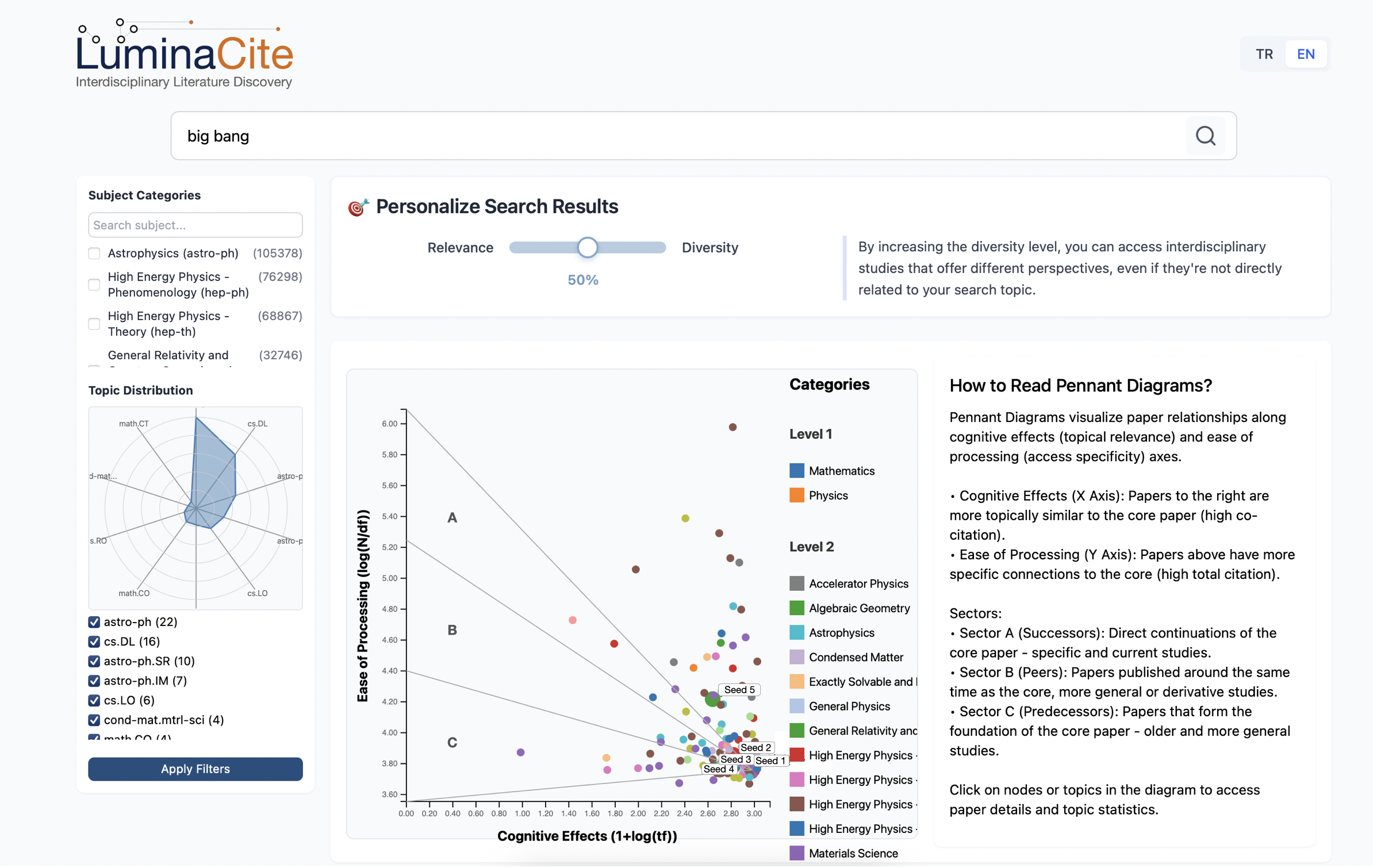
To make these ideas more concrete, we developed an interactive prototype called LuminaCite (see Fig. 1). Rather than presenting a fixed ranked list, LuminaCite allows users to adjust a simple slider that controls the balance between relevance and diversity. As the slider is moved, the ranking updates immediately, allowing users to see how different retrieval strategies reshape the result set. The system is intended as a proof of concept rather than a production search engine, but it demonstrates a simple principle: retrieval systems can expose meaningful parameters without requiring technical expertise.
In practice, search becomes less a static output and more an exploratory process. Users are not required to understand the underlying models, but they can observe how different emphases produce different kinds of results and adjust their search strategy accordingly.
At the same time, there are clear limitations. The approach depends on data availability, citation density, and computational resources, and it has been evaluated primarily within a physics corpus. Citation practices, vocabulary structure, and publication dynamics vary across fields, so further validation is needed in other domains.
More broadly, integrating interactive retrieval mechanisms into large-scale scholarly systems would present significant technical and infrastructural challenges, particularly for platforms operating at the scale of global bibliographic databases. These systems must balance computational cost, responsiveness, and result stability while serving large and diverse user populations.
For this reason, the approach should be seen not as an immediately deployable feature for existing search engines, but as an exploratory step. It helps clarify what future systems might look like if they treated rankings not only as outputs to be consumed, but as processes that can sometimes be adjusted during use.
As the volume of scientific literature continues to grow, the challenge is no longer only how to retrieve relevant papers, but how to support different ways of searching. Researchers do not always want the same kind of result, and a single fixed ranking cannot reflect that diversity of need.
Our study offers one possible direction: a retrieval model inspired by topic structure, citation networks, and ideas from Relevance Theory, combined in a system where users can incrementally adjust how results are generated. Rather than treating ranking as an endpoint, this approach treats it as something that can be refined through interaction. This perspective is becoming even more important as AI systems are increasingly involved in scholarly discovery. AI-assisted discovery systems combine retrieval, ranking, evaluation of retrieved sources, and question answering into a single interaction, blurring distinctions that traditionally separate information retrieval from downstream knowledge use.
The full open access paper (DOI: 10.1002/asi.70101) provides the technical details, evaluation, and implementation of the LuminaCite system. A visual overview of the study is available here: https://mugeakbulut.com/incremental_refinement/. We hope it contributes to ongoing discussions about how future search systems can better reflect the varied and evolving ways researchers engage with scientific knowledge.