Original

When Does a Chatbot’s Answer Become a Document You Can Trust?

When Does a Chatbot’s Answer Become a Document You Can Trust?

Dr. Sascha Donner

One evening I sat down with ChatGPT to discuss information science’s core artifact – the document. First, we had a sustained philosophical exchange about the notion of testimony and the limits of large language models. Then, at one point, ChatGPT introduced a fictional AI persona named ANNA (Artificial Neural Narrative Agent) as part of a thought experiment, and formulated CHARTA ANNA, an ethical code for the coexistence of humans and machines, and wanted me to sign or attest to it. It felt strange, and I resisted. Should I sign it for the machine, for myself, or for what reason, and would the machine use it against me in a not-too-distant future? After some back-and-forth, I asked ChatGPT a simple question: had we just created a document, or only a piece of text? Its answer surprised me. It said the LLM-generated text could not become a document on its own. Only a human could make it one, by taking it up, standing behind it, and deciding it mattered. That was why ChatGPT wanted me to sign it.

I knew I was talking to a machine; somehow, though, this dialogue moved me. That moment became the seed of a study I recently published in JASIST, titled “When AI outputs become documents: Documentation activity in human–AI dialogue“. The question behind it is one almost all of us now face in some form. Every day, millions of people ask an AI system to draft an email, summarize a report, explain a diagnosis, or write a paragraph they will pass on to someone else. The text that comes back looks good and mostly professional. It is fluent, confident, and often useful. But is it a document in the way a signed letter, a traditional medical record, or a court filing is a document? And if something in it turns out to be wrong, who answers for it?

To see why this is a real puzzle and not just a philosophical one, it helps to remind ourselves what a document has always depended on. When you read an ordinary text, you assume that somewhere behind it is a person who encountered the world, formed a view, and can in principle be asked about it. A journalist saw the event. A doctor examined the patient. Even an anonymous pamphlet was written by someone who could, at least in theory, be held accountable. Information scholars, and in particular neo-documentalists, have long argued that a thing becomes a document not because of what it is, but because of its informativeness, how people use it, and how they answer for it. This holds for text documents but also for natural entities. A stone in a field already bears the traces of its making; gathered into a museum case, labeled and cared for, it is taken up as evidence and conferred a documentary status.

—Unlike a stone, which is causally bound to the nature it attests, an LLM output is only statistically related to its underlying testimonial traces, and becomes an accountable document not of its own power but only as a person frames it, fixes it, and answers for it—

LLM systems unsettle this quiet assumption about testimony and evidence. Their answers are stitched together, word by word, from patterns in a vast ocean of human writing. No single person saw, judged, or vouched for what any particular sentence claims. In earlier work, I called this kind of output artificially blended testimony (ABT). The text an LLM outputs looks like human testimony, yet no identifiable human witness is connected to it. That testimony gap is easy to miss, because the writing is so smooth, and it grows more tempting to overlook as these systems improve.

So how does a witness-less piece of text ever come to function as a trustworthy document? To find out, I did something unusual. I treated my own conversation with ChatGPT, the one that produced ANNA, as a reflexive case to study closely, turn by turn. I wanted to watch, in slow motion, the small human acts by which a stream of machine-generated words gets turned into something a person is willing to stand behind. The full dialogue is openly available so that anyone can check my reading against what actually happened.

Three patterns of human documentary practices emerged, which I came to call framing, making, and overseeing.

  • Framing happens before and around the text: the person sets the purpose, states what the output is for, and marks its limits, so it is clear what the text is and is not meant to do.
  • Making is the act of fixing a fluid, easily regenerated answer into something stable, a fixed, dated, and citable artifact that can be kept and referred back to.
  • Overseeing is all about accountability: a person checks the output, corrects it, decides where it belongs, and takes responsibility for the result.

Together, these practices quietly convert a plausible-looking answer into an accountable document someone can trust and cite.

The most important thing I found is that documentary trust is not a switch that flips from off to on. This documentary force, inherent in what Vivien Petras calls manifested information, is never 0 and never 100, but builds in degrees through upstream and downstream documentary practices. An AI answer does not arrive as a finished document, and it does not arrive as nothing. It arrives as raw material on which trust can be conferred, weakly at first, and strengthened as a person frames it, fixes it, checks it, and stands behind it. The machine supplies the words. The human supplies the answerability. That, I argue, is the real dividing line. And the human responsibility needs to be declarable.

This matters well beyond a single conversation with a chatbot. Much of the current debate about AI text fixes on detection and disclosure, on catching AI use or labeling it. Those tools and labels have their place, but they only tell you where a text came from. They do not tell you whether and how anyone has taken responsibility for it, which is the thing a reader actually needs to know. Recording that human work, rather than merely flagging the machine’s involvement, is the more sustainable response to the current development, and it happens to be the oldest task of the information science professions, carried to a new kind of object.

The next time an AI hands you a confident answer, it is worth pausing on the small question ANNA’s charter raised for me that evening. The text may be useful, even excellent. But it is not yet a document you can trust until a person has framed it, fixed it, checked it, and agreed to answer for it. The machine can write. But only humans can be accountable. Building the habits, and eventually the institutions, that record that accountability in this new era may be one of the more important tasks of the years ahead.
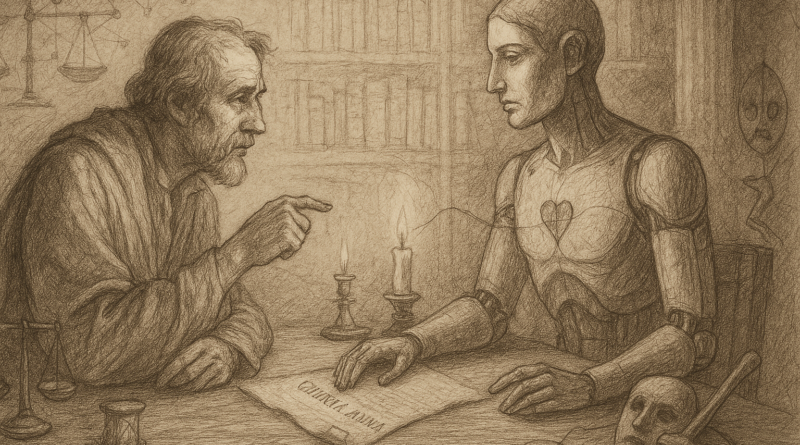
A sepia, pencil-style drawing of an elderly bearded scholar and a humanlike machine seated across a candlelit table, facing each other in conversation. The scholar gestures with one hand; the machine, with visible mechanical joints and a heart drawn on its chest, rests its hands on a document lying between them. Bookshelves fill the background, and a set of scales, an hourglass, and a theatre mask surround the scene.
Image generated by ChatGPT when asked to depict the dialogue this article studies. A human and a machine across the table, the CHARTA ANNA between them.

Cite this article in APA as: Donner, S. (2026, October 14). When does a chatbot’s answer become a document you can trust? Information Matters. https://informationmatters.org/2026/09/when-does-a-chatbots-answer-become-a-document-you-can-trust/

Author

  • Sascha Donner

    Dr. Sascha Donner is a researcher at the Berlin School of Library and Information Science, Humboldt-Universität zu Berlin. His research focuses on the intersection of document theory, human–AI collaboration, and the future of information practices. He has introduced the concept of “artificially blended testimony” (ABT) to describe the role of AI-generated outputs in documentation and developed the Model of Documentation Activity to study how emerging technologies shape human-AI meaning-making processes. https://doi.org/10.18452/38772

    View all posts
Subscribe to IM weekly updates