
Invisible Achievers No More: A Library Initiative for Building Belonging Among Distance Learners
Wellbeing: A New Role for academic libraries
Over the years academic libraries were seen as a place for knowledge material, research help, and study skills. This is still true. But it is no longer the whole picture. Over the last ten years or so, libraries around the world have slowly taken on a new role. Many now see supporting student wellbeing as a natural part of their work, not something separate from it.
This change has a fairly clear starting point. In 2017, Universities UK launched a framework called ‘StepChange’. It asked universities to take a ‘whole-university approach’ to student mental health. Mental health is not simply the absence of illness, but a state of well-being in which an individual realizes their own potential, can cope with the normal stresses of life, can work productively, and is able to make a contribution to their community. The whole university approach gave libraries a clearer reason to act on something they already felt from daily contact with students. The library is one of the few places’ students keep coming back to, which puts staff in a good position to notice when someone is struggling and to offer quiet, informal support.
The Association of College and Research Libraries (ACRL) documented the role of libraries in student wellbeing in their 2020 and 2024 reports. A review by Marta Bladek (2021) found four main ways libraries support student wellbeing: special programmes, partnerships with university wellness services, more welcoming library spaces, and collections that support wellbeing directly. A latest review by Suresh et al. (2025) found eleven types of wellbeing activities now used in academic libraries worldwide — including, notably, activities that help students talk about belonging and identity.
Psychologist Abraham Maslow placed belonging and recognition among the higher human needs—needs that must be met before a person can fully grow. For distance learners, whose contact with the university and each other is already limited, this is the heart of the problem KRC (Kandy Regional Centre) Library: a regional centre library of the OUSL wanted to address.
The Idea, and the Event
KRC library frequently hosts events to increase student engagement, bringing students from diverse environments together. In their annual event calendar for 2025 was a special programme in August to celebrate International Youth Day: “From Dreams to Action.”
The idea for “From Dreams to Action” did not come from a formal planning meeting. It came from everyday conversations at the library counter. One regular visitor—a student working on IT projects—would often stop to talk about his latest work. He was quietly frustrated that hardly anyone outside his small circle of friends knew about it. His situation was not rare. Through many informal conversations with students, library staff identified a number of individuals who had achieved remarkable success in areas such as entrepreneurship, community leadership, and professional development, often alongside strong academic performance. However, these achievements frequently remained unrecognized within the university community. It shows that talent existed but visibility did not. The library, which sits at the centre of student life on any campus, was the natural place to close that gap. Giving these talents visibility was about identity, connection, and belonging in distance education.
The library launched a programme with five clear goals: to formally recognize student achievement beyond academic work, to inspire other students through real success stories, to build confidence and wellbeing through visibility and self-expression, to strengthen the library’s role as a community hub, and to create connections across faculties — all of which distance education rarely creates on its own.
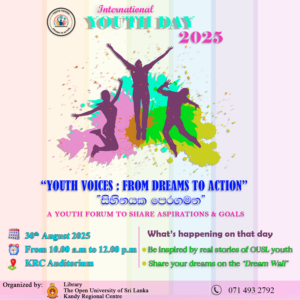
Eligible candidates were identified by the library itself and by coordinating with student groups and academic staff. Once candidates were approached, the library team held Zoom meetings with them to brief them on the format of the programme. Photographs and short profiles were gathered. The forum was designed as a moderated discussion rather than a formal presentation, precisely because the goal was conversation, not performance. Setting a date was challenging because distance learners had to balance studies with employment, family responsibilities, and other personal commitments, making it difficult to bring everyone together at the same time. At the end five speakers were confirmed: a cake designer from the Faculty of Engineering, a yoga instructor from Social Sciences, a mushroom entrepreneur from Management Studies, a social activist from Natural Sciences, and a freelance software developer from the Faculty of Engineering Technology — the library team already knew that what these students carried was extraordinary.
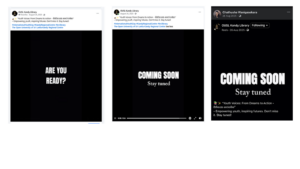
The library launched a modest promotion campaign through printed posters, email notifications, Facebook posts in the weeks before the event, and direct communication through academic coordinators. Hashtags anchored the campaign.
The event was held on 30 August 2025 at the KRC auditorium — chosen to signal that this was not a quiet side event but something the institution stood behind. Over 100 students attended. A past OUSL student, now a practising lawyer, moderated the discussion in a relaxed, conversational style. Speakers spoke honestly about what motivated them to start, their hardest moments, and how they balanced study with everything else in their lives. In between discussions, student performers provided entertainment, helping to keep the room lively and welcoming.
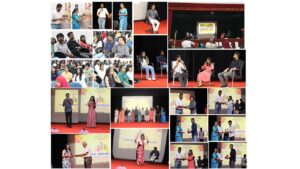
The Event – Conversation, Entertainment, Appreciation
The Impact
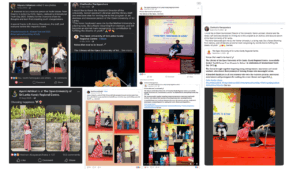
When the formal session ended, the conversations did not. Students exchanged contact details across faculties and kept talking about ideas the forum had sparked. Photos from the event spread quickly across social media, with students tagging one another for days afterward. Many said they felt more motivated and more aware of what was possible, even while studying at a distance. The speakers, some of whom had felt unseen before, found themselves publicly recognised by their university community. The benefits went both ways. Students gained recognition. The library gained a clearer sense of its own changing identity — moving from a traditional study-support space toward a place that actively reduces the isolation built into distance education. The invisible achievers are invisible no more. All it took was a library willing to listen, and a room to fill.
AI Disclosure
The author acknowledges the use of generative AI tool (Claude) for providing language support during the drafting process.
Acknowledgement
The author gratefully acknowledges the support, cooperation, and assistance extended by the Assistant Director and the staff of the Centre towards the successful implementation of this event.