
Users’ Perspectives on Content Moderation of Web Search Autocomplete Suggestions
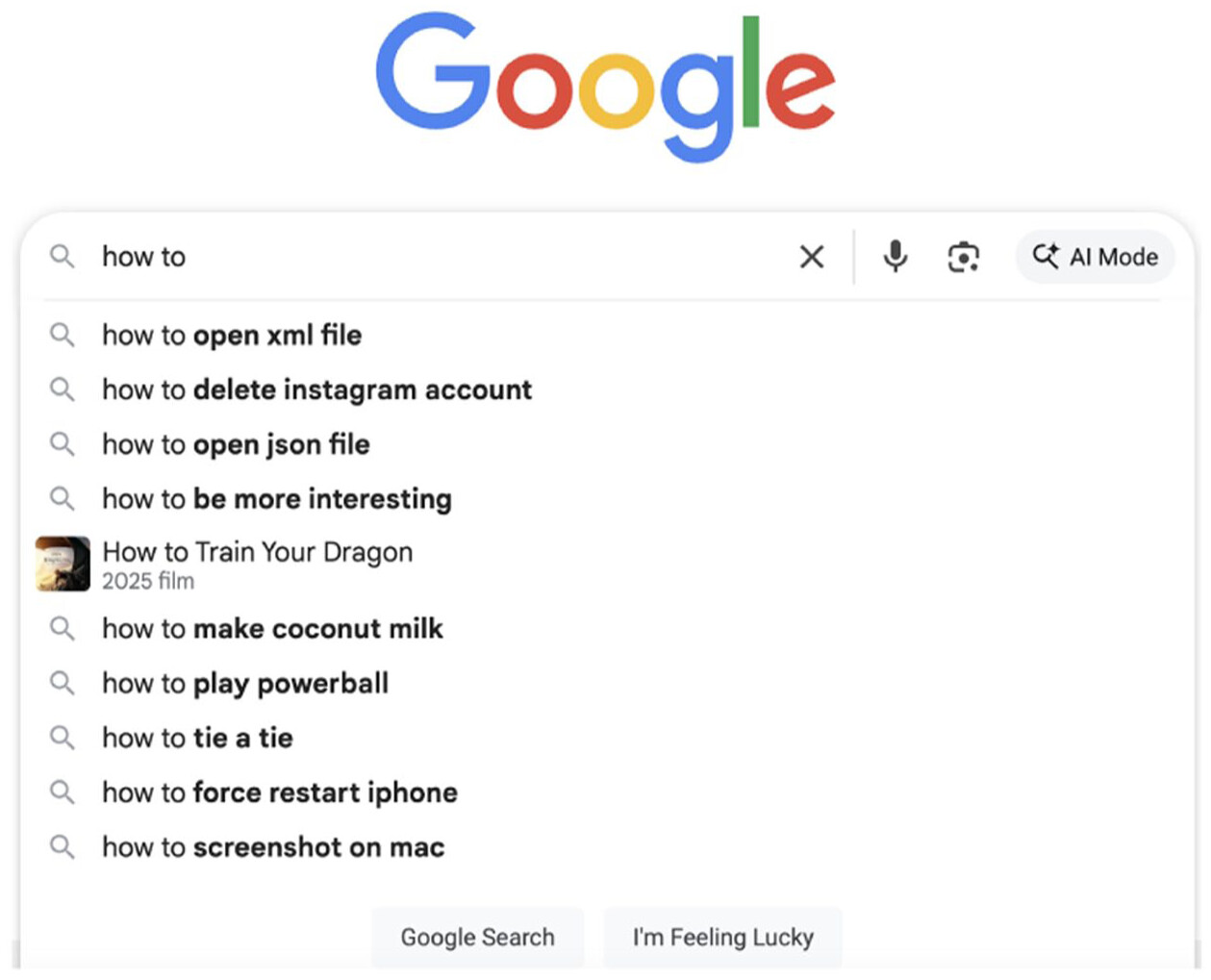
While users highly trust search outputs, autocompletes can include inappropriate suggestions, such as misinformation, biases against specific groups, and stereotypes. This is concerning because repeated exposure to biased or skewed autocompletes tends to shift people’s attitudes in the direction of the bias. Thus, there is a need to “moderate”, i.e., prevent inappropriate autocompletes from appearing before the users.
The prospect of moderating Autocomplete suggestions raises a range of ethical, technical, and political questions, such as how to distinguish between appropriate and inappropriate suggestions, who should have the power to make such distinctions, and how these decisions should be communicated to end-users. This article takes a user-centered approach to interrogating these questions. By conducting semi-structured interviews with 20 regular users of search platforms, I examine how users make sense of Autocomplete moderation, what concerns they have about its procedures, and how they seek to assert greater agency within the process.
My reflexive thematic analysis of this interview data shows a broad consensus for instituting at least a baseline level of search moderation to detect and remove overtly inappropriate autocompletes, e.g., those that lead to illegal content. My participants relied on their ethical values (i.e., a desire for “truth” and “decency”) and prior media use to conceive of additional content types (e.g., fake news, identity-based stereotypes) that should be regulated within search information cues.
Participants recognized that suggestions that fall in the gray area of moderation pose the challenge of determining where (and how) to draw the lines for content removal. They viewed search moderation as a compromise between ascertaining information quality and having access to diverse viewpoints, yet they found it challenging to envisage how such compromise can be achieved or what steps it would entail.
Relatedly, the question of agency looms large in my interview data: who exactly should have the authority and responsibility to draw the lines for autocomplete removals? On this question, participants largely held platforms responsible for inappropriate autocompletes, and expected them to make sensible decisions, e.g., removing instances of hate speech and misinformation. Indeed, participants reported a higher expectation of search moderation as compared to social media moderation.
On the other hand, participants appreciated the political, technological, and scaling challenges that search systems face in enacting autocomplete moderation. They also realized the pivotal roles that other stakeholders, including website providers, lawmakers, and users themselves, must play to improve the quality of search outputs.
My findings show that users are increasingly losing confidence in search moderation, especially in more recent years. While participants still put greater trust in search engines as compared to social media platforms, this growing mistrust may reflect a response to the capitalist logics of search platforms that are getting increasingly visibilized through news reports and academic research.
Participants deemed flagging (or reporting) mechanisms as a valuable regulation approach that can empower end-users to have a voice in search moderation. However, all participants agreed that the discoverability of flags is severely limited within popular search interfaces. They desired to receive regular updates about flag reviews and an explanation of review outcomes. Additionally, participants wanted more visibility into the autocomplete moderation process, including access to sources behind each suggestion. This indicates that the principles of procedural fairness, accountability, and transparency, which have so frequently guided recent social media moderation efforts continue to be relevant for search moderation as well.
Besides procedural transparency, my participants also frequency evoked a need for greater control and customizability in autocomplete moderation. This became most apparent in their frequent demand for personal moderation tools (e.g., blocking, muting, using word filters) to configure search autocompletes.
On the whole, this analysis illuminates how users engage in pre-retrieval sensemaking when interacting with algorithmic nudges within search platforms. Rather than treating autocomplete suggestions as neutral conduits to information, users interpret them as opaquely derived system outputs, conceive of situations when these outputs are inappropriate, and derive from their use of social media sites to envision how such outputs should be moderated.
This study contributes to research on human–algorithm interaction and information retrieval by showing how user imaginaries of algorithmic moderation influence their trust in search systems and shape expectations about their own role in shaping search infrastructures.
For more details, please check out the full text of this paper, preprint available here. Shagun Jhaver. 2026. Interpreting Algorithmic Information Cues: User Sensemaking of Search Autocomplete Moderation. Journal of the Association for Information Science and Technology (JASIST), 1–14. https://doi.org/10.1002/asi.70092