When a Foreigner Shows Us Home: Filipino Provincial Culture as Public Knowledge on YouTube
When a Foreigner Shows Us Home: Filipino Provincial Culture as Public Knowledge on YouTube
Dionar Acosta, Amber Julianne Palomares, Charlize Hayden P. De Guzman, Ma. Yvonne Miliane Bondoc, and Mickyla Cassandra Conde
Seeing Home Again
Sometimes, it takes the eyes of someone from elsewhere for us to see home again!
In a province-based YouTube series by a Korean vlogger, Filipino culture is not introduced through grand national symbols alone, but through roads, meals, local conversations, landscapes, community practices, and the quiet dignity of everyday life. What appears at first as travel content may also be read as something more meaningful: a form of public knowledge production. Through the vlogger’s encounters with different Philippine provinces, local cultures become visible, searchable, shareable, and emotionally reintroduced to audiences who may have forgotten how much cultural knowledge is carried by ordinary places.
This article reflects on how YouTube travel vlogging can help produce public knowledge about Filipino provincial culture. More specifically, it considers how the perspective of a foreigner—someone looking at the Philippines with curiosity, care, and wonder—allows Filipino viewers to recognize the familiar in a renewed way. In this sense, the series is not only about a foreigner discovering the Philippines. It is also about Filipinos seeing themselves again through the foreigner’s gaze.
When Travel Becomes Knowledge
Have you ever wanted to travel the world, but ended up doing so through a screen instead? In an age where media shapes much of what we know about places, people, and cultures, travel is no longer limited to physical movement. Sometimes, it begins with a YouTube video.
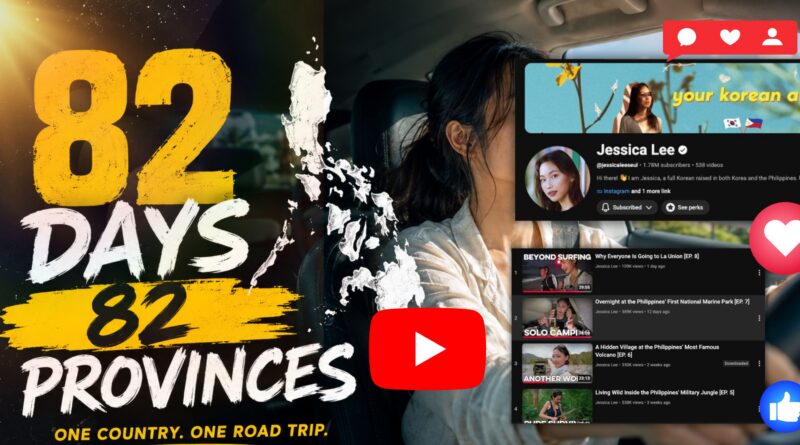
This is what makes Jessica Lee’s Probinsya series more than just entertainment. As she travels across the Philippines, the series becomes a way of seeing our home through foreign eyes. There is something fascinating about watching a foreigner introduce us to places that have always been ours. Through Jessica’s perspective, familiar landscapes, local traditions, livelihoods, and everyday encounters take on new meanings.
The series reminds us that there is still so much about our own country that we do not know. Probinsya reveals details that have always been there but often gone unnoticed. What may seem ordinary to locals becomes worthy of curiosity, documentation, and appreciation. Through YouTube, these experiences are recorded and shared, allowing provincial stories and cultures to reach audiences far beyond their local communities. In this sense, the series functions as an informal cultural archive. Through storytelling, visuals, and human connection, Filipino provincial culture is transformed into public knowledge; something shared, remembered, and continually rediscovered. There is always more to see, more to know, and more to learn.
We find familiarity in the foreign – proving that sometimes we understand home best when we see it through someone else’s eyes.
But if Probinsya turns travel into knowledge, it also does something more intimate: it turns the foreign gaze into a mirror. The series does not simply show the Philippines to the world; it also shows the Philippines back to Filipinos. In watching Jessica Lee notice, ask, admire, and listen, Filipino viewers are invited to confront an uncomfortable truth: many of the things she finds beautiful are things we have learned to overlook, dismiss, or even undervalue. This is where the series becomes more than documentation. It becomes an act of cultural re-seeing.
The Foreigner’s Gaze and the Province’s Memory
While the series is still ongoing, it has already highlighted core Filipino values such as kabutihang loob, kapwa, and bayanihan through her simple interactions with others. This style of storytelling is in contrast to the sensationalism other vloggers tend to use: Lee sees what is on the surface but digs deeper and brings the viewer along with her. Her videos help us realize that the beauty of our people shines through every day, in every second of our lives, and that if we acknowledge it too, we could be living out the real Filipino dream of finding prosperity and happiness at home.
This renewed way of seeing does not remain abstract. It becomes visible in the specific cultural details that the series chooses to dwell on: the food people prepare, the stories they tell, the dialects they speak, the places they preserve, and the ways they welcome a stranger into their community. In this way, the foreigner’s gaze does not only mirror Filipino identity; it also points us toward the everyday spaces where that identity continues to live.
Here in the Philippines, culture is not only seen in festivals or historical landmarks, but also in the everyday lives of ordinary people. Through her visits to different provinces, the series presents Filipino culture as lived and experienced daily rather than confined to textbooks or tourist attractions.
One recurring theme throughout the episodes is food as memory and identity. In episode 3, where Jessica explores Pampanga, the culinary capital of our country, food becomes central to Kapampangan culture. Local dishes are not simply introduced as delicacies, but as symbols of history, family, and local pride. The resident’s passion for cooking and sharing recipes shows that traditions are preserved through food and storytelling. The episode also highlights Filipino hospitality, or pakikipagkapwa, as Jessica is warmly welcomed into homes, eateries, and community spaces. The series also emphasizes how deeply connected Filipinos are to their local roots and traditions. Residents proudly share their dialects, products, customs, daily lives, and landscapes, revealing that Filipino culture is not singular or centered on Manila. Instead, each province preserves its own identity through everyday practices such as cooking, storytelling, farming, and community gatherings, allowing culture to continue to live on in provincial life.
Yet these provincial practices do not remain confined within the communities where they are lived. Through Jessica Lee’s videos, the food, stories, dialects, landscapes, and everyday gestures of local people travel beyond their immediate settings and enter a wider digital space. What begins as a local encounter becomes part of a shared online conversation, where viewers can watch, remember, comment, and pass these cultural meanings on to others.
YouTube and the Circulation of Culture
Through YouTube, Probinsya turns provincial culture into circulating public knowledge. Local practices, places, foodways, and stories that may have once remained within specific communities become searchable, shareable, and emotionally accessible to viewers who may never have visited these provinces. The platform does not only display culture; it allows culture to travel, gather responses, and become part of a wider public conversation.
This is evident in how viewers connect the vlog’s intimate moments to their own memories. One comment reflects on Sir Marcos’ statement that a house “comes alive” when it feeds people, relating it to familiar Filipino gatherings where relatives cook, eat, and tell stories together. Here, YouTube becomes more than a viewing platform. It becomes a space where audiences attach personal memory to cultural information, extending the meaning of the vlog beyond the video itself.

The same circulation of knowledge appears in the discussion of buro (20:25–21:05), a traditional Kapampangan fermented rice dish. Rather than presenting it only as food, the vlog explains its preparation, significance, and place in regional identity. A local culinary practice becomes accessible to wider audiences through visual storytelling. The later discussion on Michelin stars (21:37–22:40) deepens this point by questioning why Filipino food should need Western validation to be considered valuable. In this moment, the vlog becomes a site where cultural worth is not merely displayed but debated.
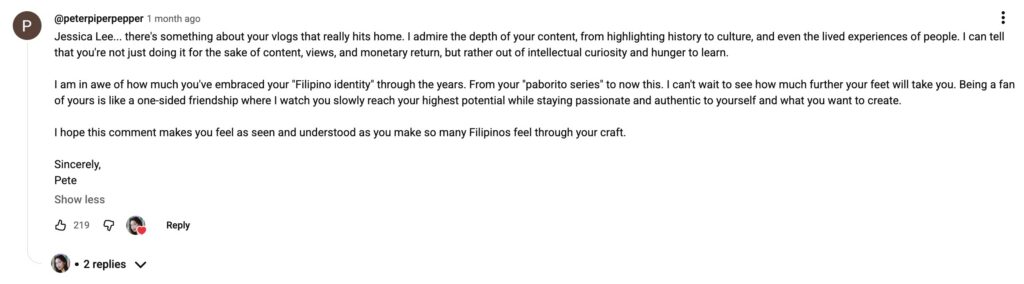
These interactions show how viewers do not simply consume content. Through comments, shares, recommendations, and reflections, they participate in interpreting and circulating cultural knowledge. In Probinsya, YouTube becomes a digital space where local stories move beyond geography and become part of what people know, remember, and value about Filipino provincial culture.
Returning to Ourselves
In the end, Probinsya matters not only because it shows the Philippines to a wider public, but because it returns the Philippines to Filipinos in a more attentive and meaningful way. Through Jessica Lee’s journeys, provincial culture becomes more than scenery, cuisine, or digital content; it becomes public knowledge shaped by encounters, memories, comments, and shared circulation. The series reminds us that culture does not live only in official archives, textbooks, museums, or tourism campaigns. It lives in homes that feed people, in recipes passed from one generation to another, in dialects spoken with pride, in landscapes cared for by communities, and in ordinary conversations that carry the weight of memory.
When these stories travel through YouTube, they do more than inform; they invite viewers to pause, remember, and look again.
Sometimes, seeing ourselves through another’s wonder becomes the first step in returning to ourselves.