Who Is Research For? Rethinking Information Privilege
This is what information privilege looks like in everyday research practice. Universities reward publications. Journals measure impact through citations. Scholars gain recognition. Meanwhile, participants—especially those in marginalized communities—often remain outside the circle of knowledge circulation. The very people whose experiences form the foundation of research may never see how their stories were interpreted.
Instead of accepting this as inevitable, I decided to try something different.
I organized a one-day workshop with fifty Advanced Level students (aged 18–20) in a tea estate of Sri Lanka, my research site. The theme was “Digital tools and platforms: opportunities, risks, and coping strategies.” Rather than presenting academic slides in English, I shared my findings in Tamil—the language they speak daily. For many of them, this was the first time they heard a collective summary of what youth in their own community had expressed.
Something changed in that space. The workshop became a conversation. Students spoke openly about online harassment, privacy concerns, and social judgement. They explained how they navigated risks and supported one another. They questioned my interpretations. They added new layers to the findings. Knowledge was no longer something I “produced.” It became something we discussed together.
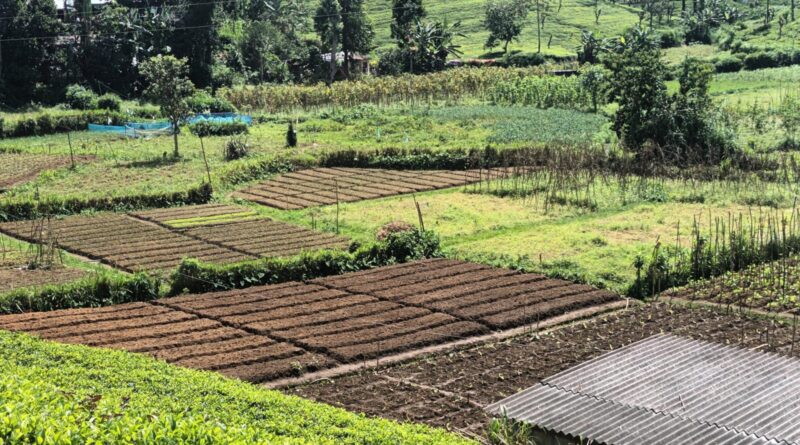
I also used photovoice, which offered another powerful way for youth to share their experiences. the participants youth shared photographs which shared impact on digital platforms. The following images shared by two participants, image 1 represent, nourish vegetable garden where get information regarding plant disease His story, accompanied by image 1, which shows his flourishing vegetable garden, demonstrates how digital inclusion enables small-scale farmers to exercise greater control over their economic activities and reduce dependence on exploitative systems.

Similarly, a mushroom farmer who studied only up to Ordinary Level and lacked formal qualifications. Despite this, he now earns around Rs. 100,000 per month, a significant amount within the local context. “I learned everything about mushroom cultivation, including growth techniques, disease prevention, and pest control, through Google and YouTube. The training given by the Agriculture Department was mostly theoretical, but I gained practical skills online,” he explained.
Demonstrating innovation and digital problem-solving, he built his own mist maker machine for his mushroom farm by watching YouTube tutorials. Instead of purchasing a costly commercial version (cost Rs.85,000/-), he ordered parts from China and assembled the machine himself, saving money and improving productivity (total cost he spent about Rs. 45,000/-). He also sources most of his farming supplies online, eliminating the need to visit distant agricultural stores. His photovoice submission (image 2) showcases the mist maker he built, symbolizing how digital knowledge can directly translate into practical economic solutions.

Their experiences illustrate how digital inclusion significantly enhances the performance of self-employed individuals. As a result of these digitally enabled economic activities, youth in the tea estates are witnessing gradual improvements in their financial independence. Based on these photographs collection, I am planning to do the exhibition in a community hall or school , where families and local leaders can see them. Such collective image exhibitions can inspire local youth to see how digital platforms create new opportunities. In this way, a photovoice exhibition transforms research from a private academic product into a shared public conversation.
I am also exploring turning selected case studies into short comic stories written in Tamil. Comics can communicate complex issues—digital inequality, aspiration, coping strategies—in ways that feel accessible and engaging. If these comics are made available in local public libraries and school libraries, the research moves beyond university repositories and into everyday community spaces. Libraries, in this sense, become bridges between academic knowledge and local life.
None of this replaces academic publishing. Scholarly journals matter. They provide peer review and intellectual exchange. But if research is meant to contribute to social understanding or empowerment, then dissemination cannot end with publication.
Citations measure one kind of impact. Community understanding measures another.
When research findings are discussed in youth workshops, displayed in photovoice exhibitions, or placed on the shelves of local libraries in the language of the community, information privilege begins to loosen its grip. Knowledge travels back. It becomes visible to the people who made it possible.
So perhaps the question is not simply “How many people cited my article?” but also “Did the people who shared their lives with me recognize themselves in the final story?”
If research is truly for society, then knowledge must return home—not only to citations, but to conversations, exhibitions, and libraries where communities recognize themselves in the story.