Why Slow Journal Decisions Hurt More Than We Think
Where the data came from
To study this, we used more than 33,000 author-reported submission records from LetPub, an online platform where researchers share their journal submission experiences. The records contain submission dates, final outcomes, journal names, and the ratings that authors give to journals. This allowed us to ask a clean and simple question: when journals take longer to reach a decision, do authors rate them less favorably?
What the data told us
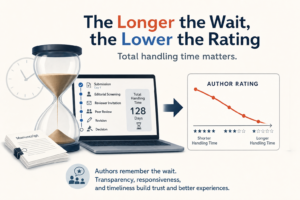
The answer was a clear yes. Across all our models, longer total handling time was consistently linked to lower author ratings. This remained true even after we accounted for whether the paper was accepted or rejected, and after controlling for journal features such as open access status, publication volume, journal age, self-citation rate, and impact factor. In other words, authors were not simply giving low scores because their papers were turned down. The long wait itself pulled the ratings down.
 Now, this does not mean that every slow review process is bad. Careful peer review takes time. Good reviewers are busy, editors must coordinate many people at once, and complex papers deserve deeper assessment. Our finding is not an argument for rushing the process or dropping quality standards. Rather, it shows that time is a real part of the author experience, and authors notice deeply when the process feels slow, uncertain, or poorly managed.
Differences across fields and journals
We also found that the connection between handling time and author ratings differs by discipline. In fields like medicine, materials science, physics, and mathematics, longer delays were tied to even sharper drops in ratings. These are fields where timing can be especially critical, whether because the research moves fast, priority races are fierce, or career and project deadlines simply do not bend. In other fields, researchers may be more used to long review cycles and therefore a bit more forgiving of delay.
Journal reputation plays a role too. Top tier journals seemed to suffer less from the negative effects of long handling times. Authors may expect prestigious venues to take more time, linking a slow process with selectivity and rigor. For mid tier journals, however, the penalty for delay felt stronger. These journals may lack the reputational buffer that can absorb authors’ frustration when the process drags on.
Publication frequency gave us another interesting signal. Journals that publish less often may face greater dissatisfaction when handling times stretch out. From an author’s view, a slow decision from a journal that appears only a few times a year can feel especially costly because publication slots are scarce from the start. High frequency journals, by contrast, might benefit from authors’ belief that they naturally manage larger manuscript flows and heavier editorial workloads.
What journals can do
So what should journals take from this? The real lesson is not simply “be faster.” It is to become more predictable, more transparent, and more responsive. Authors can often accept a long process if they understand what is happening and if the timelines are communicated clearly. Silence makes the waiting much harder. Even modest steps, such as clearer status updates, realistic time estimates, quicker desk decisions, and better reviewer matching, can measurably improve how authors experience the process.
A growing source of shared experience
For authors, online review platforms are becoming a valuable collective memory. They let researchers compare not just prestige indicators but also the lived experience of submitting to a journal. This does not replace traditional measures of journal quality. It adds another layer, revealing how journals treat authors during the whole publication journey.
For the scholarly publishing community, our study points to something broader. Journals are not only gatekeepers of academic quality. They are also service organizations operating inside a highly competitive and time-sensitive research system. When authors rate journals publicly, they are not merely reacting to acceptance or rejection. They are evaluating the fairness, efficiency, and transparency of the entire process.
Waiting has always been part of peer review. In today’ academic environment, however, that waiting is no longer invisible. Authors can record it, compare it, and share exactly how it shaped their experience. If journals want to protect their reputation, they need to pay attention not only to what decisions they make, but also to how long those decisions take and to how authors experience the time in between.
Anyone who has submitted a research paper knows the feeling. After months or years of work, the manuscript disappears into the peer review system. Days become weeks, weeks become months. You keep checking the submission portal, waiting for an answer. The final outcome certainly matters. Acceptance brings relief, rejection brings disappointment. But our study finds that the wait itself also matters, and more than we usually admit.
In academic publishing, journals are often judged by familiar numbers: impact factor, citation counts, rankings. These indicators tell us something about scholarly influence. They do not, however, tell us much about what it feels like to submit to a journal. For authors, especially early career researchers or those racing against promotion and funding deadlines, time is far from a minor detail. It can shift career plans, delay grant applications, extend graduation timelines, and slow the moment when new findings meet the world.
Our recent study looked at this issue directly from the author’s point of view. We focused on “total handling time,” the entire period from initial submission to the final editorial decision, whether that decision is acceptance or rejection. This timeframe is larger than the peer review duration alone. It captures all the stages that authors experience as waiting: editorial screening, reviewer invitations, the review process itself, revisions, and the final decision. Simply put, it is the time when your work sits in the journal’s hands.