When Censorship Breaks Mirrors: Why Critical Cultural Literacy Depends on Diverse Stories
Why This Moment Matters Now
Book challenges have increased sharply in recent years. According to the American Library Association, reported challenges rose dramatically beginning in 2021, with thousands of titles targeted annually (American Library Association, 2024). The pattern is consistent; the most frequently challenged materials center Black, Indigenous, and other people of color, LGBTQIA+ identities, and topics related to gender, sexuality, and historical injustice (Friedman, 2023).
This is not random, and it has infested the inner workings of the profession, in the form of self-censorship (Cooke & Harris, 2023). This crisis reflects ongoing struggles over whose knowledge is considered legitimate, and whose stories are valued and worth telling. These debates are often framed as political or moral conflicts; they are that, but they are also literacy issues.
Censorship Is a Literacy Issue
When young people lose access to diverse authentic texts, they lose opportunities to develop critical literacy. They lose practice in asking: Who created a text? Whose perspectives are included? And whose perspectives are missing? They lose opportunities to question dominant narratives and to understand how power shapes information. They lose opportunities to see themselves or learn about others.
Critical literacy moves beyond comprehension. It asks readers to analyze how texts construct meaning and how those meanings reinforce or challenge social norms. Scholars such as Freire (1970) and Luke (2014) argue that literacy is tied to power, agency, and the ability to participate fully in society. These restrictions shape not only what young people read, but how they seek, evaluate, and trust information (Cooke, 2017).
Critical Cultural Literacy and the Question of Power
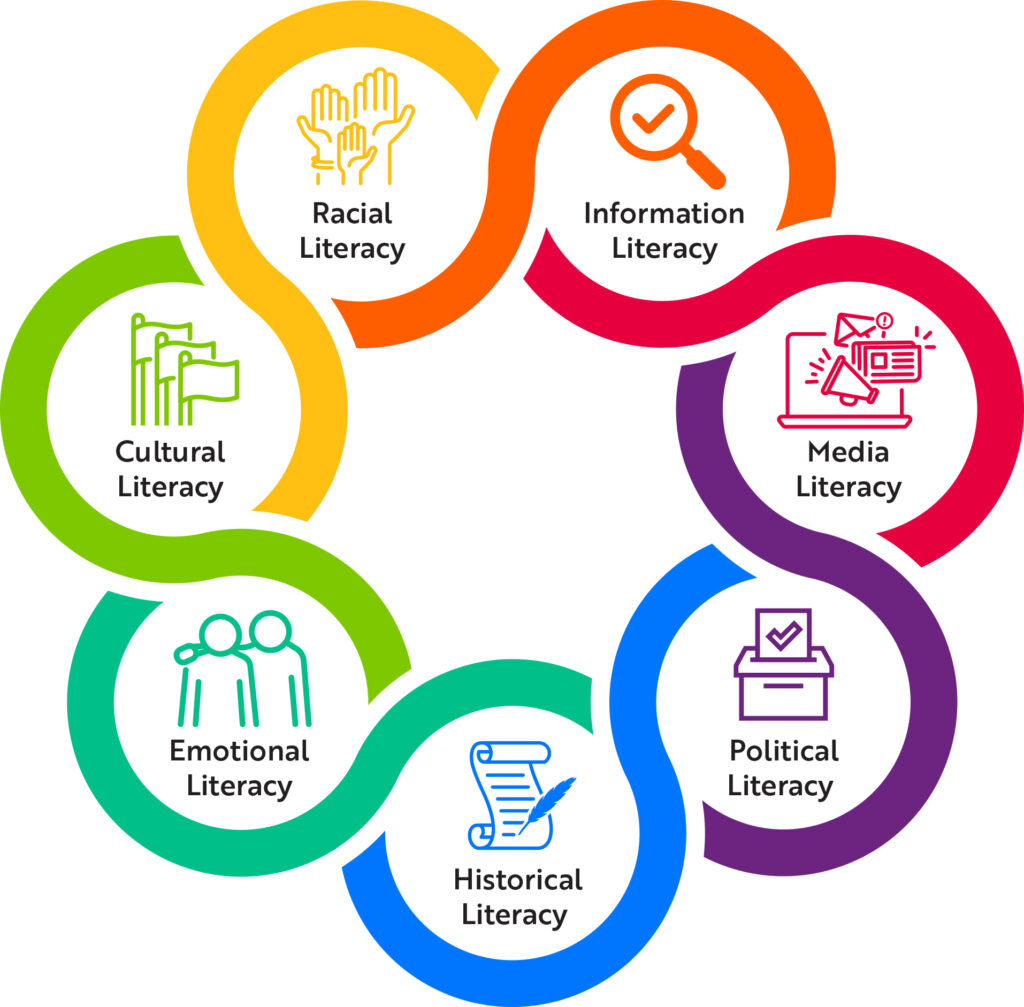
Critical cultural literacy (CCL) offers a model for reading information through context, power, and lived experience rather than treating false or harmful claims as isolated errors. In Cooke’s framework (2021), CCL brings together cultural competence and humility with critical information, media, design, political, historical, emotional, and racial literacies. The model asks readers, educators, and information professionals to examine who created a message, whose interests it serves, which histories it hides, which groups it harms, and which voices it leaves out. Its value lies in moving beyond quick fact-checking toward a deeper understanding of how racist and racialized malinformation becomes normalized through repetition across media, schools, politics, popular culture, and everyday social life. The critical cultural literacy model makes one point clear: Literacy is never neutral (Cooke, 2021).
Every text emerges from a cultural context shaped by history, power, ideology, and inherent biases. What is published, taught, or removed reflects decisions about whose voices matter and whose voices have been suppressed or erased. Teaching students to read critically and develop CCL means helping them recognize those systems.
This approach builds agency. Students learn that knowledge is constructed and they learn to question authority rather than accept it at face value. They become more capable of identifying bias, recognizing gaps, and resisting manipulation (Elmborg, 2006). Research reinforces the importance of representation in this process. Students who see themselves reflected in what they read report higher levels of belonging, which is linked to engagement and persistence in learning.
Mirrors, Windows, and Sliding Glass Doors
Dr. Rudine Sims Bishop’s framework of mirrors, windows, and sliding glass doors provides a clear way to understand why access to diverse texts matters (Bishop, 1990).
- Mirrors reflect a reader’s own life and identity. They affirm that a student’s experiences are real and worthy of attention.
- Windows allow readers to encounter lives different from their own. They expand understanding and challenge assumptions.
- Sliding glass doors allow readers to enter those experiences and imagine new possibilities. They support empathy and help students envision alternative futures.
Censorship disrupts all three. It breaks mirrors by removing texts that reflect marginalized identities. Students who do not see themselves represented receive a clear message about whose lives are valued. It seals windows by limiting exposure to diverse perspectives. Without those perspectives, students are more likely to rely on stereotypes or incomplete narratives. It locks sliding glass doors by restricting access to stories that allow young people to imagine change. Without those stories, possibilities feel narrower.
Censorship does more than remove books from shelves. It breaks mirrors, seals windows, and locks sliding glass doors. In doing so, it weakens the development of critical literacy (Bishop, 1990).
Responding to Claims of Harm
Supporters of book removal often argue that certain materials are inappropriate, confusing, or harmful to children. These claims deserve direct response:
- Information does not create identity. Young people do not become who they are because they encounter a book. They seek out language and representation to understand themselves.
- Silence does not create safety and silence is actually complicity in enacting harm. Avoiding difficult topics does not prevent young people from encountering them elsewhere. It only removes the support structures that help them process what they encounter.
- Avoidance does not build resilience. Critical literacy develops through engagement with complexity, not through restriction (hooks, 2010).
The Role of Digital Spaces
Censorship does not operate only through book bans. It also functions through digital systems. Algorithms shape what young people see online; some perspectives are amplified and others are buried. These systems act as invisible filters that influence knowledge access.
Critical cultural literacy must extend to these spaces. Students need to understand how platforms prioritize content and how that affects what they believe is true or important (Head et al., 2020). Limiting access to diverse books while digital platforms narrow exposure further creates a more restricted information environment.
What This Looks Like in Practice
Supporting critical literacy requires intentional action. In classrooms, educators can ask students to compare texts on the same topic and identify differences in perspective. They can guide students to ask whose voices are missing and why. They can create space for discussion about how identity shapes interpretation.
In libraries, professionals can curate collections that provide mirrors, windows, and opportunities to walk through sliding glass doors. They can design programming that encourages engagement with diverse texts, and they can communicate clearly with families about the role of representation in literacy development. This work is not about promoting a single viewpoint. It is about equipping young people with the skills to analyze multiple viewpoints.
What Is at Stake
When access to diverse texts is restricted, the consequences extend beyond individual books. Students lose opportunities to develop agency, they lose opportunities to build empathy, and they lose opportunities to engage fully in a diverse society.
Critical cultural literacy depends on access; it depends on trust in young people’s ability to think, question, and learn.
If we remove mirrors, we erase children.
If we seal windows, we narrow empathy.
If we lock doors, we shrink possibilities.
The central question is not whether certain books make adults uncomfortable. The question is whether we trust young people to think critically about the world they are inheriting. Access to stories shapes how that world is understood, and it also shapes who has the power to change it. The future of an informed society depends on whether we expand access to knowledge or continue to restrict it and the imaginations of our readers.
References
American Library Association. (2024, March 8). State of America’s Libraries Report 2024. American Library Association. https://www.ala.org/news/state-americas-libraries-report-2024
Bishop, R. S. (1990). Mirrors, windows, and sliding glass doors. Perspectives, 6(3), ix–xi.
Cooke, N. A. (2021). Tell Me Sweet Little Lies: Racism as a Form of Persistent Malinformation. PIL Provocation Series. Volume 1, Number 4. Project Information Literacy. https://projectinfolit.org/docs/provocation-series/essays/tell-me-sweet-little-lies.html
Cooke, N. A. (2017). Posttruth, truthiness, and alternative facts: Information behavior and critical information consumption for a new age. The Library Quarterly, 87(3), 211–221.
Cooke, N. A., & Harris, C. N. (2023). The softer side of censorship. Journal of Intellectual Freedom & Privacy, 8(1), 4.
Elmborg, J. (2006). Critical information literacy: Implications for instructional practice. The Journal of Academic Librarianship, 32(2), 192–199.
Freire, P. (1970). Pedagogy of the oppressed. Continuum.
Head, A. J., Fister, B., & MacMillan, M. (2020). Information Literacy in the Age of Algorithms: Student Experiences with News and Information, and the Need for Change. Project Information Literacy. https://www.projectinfolit.org/publications/algorithm-study
hooks, b. (2010). Teaching critical thinking: Practical wisdom. Routledge.
Luke, A. (2014). Defining critical literacy. In J. Z. Pandya & J. Ávila (Eds.), Moving critical literacies forward (pp. 19–31). Routledge.
Friedman, J. (2022, September 19). Banned in the USA: the Growing Movement to Censor Books in Schools. PEN America. https://pen.org/report/banned-usa-growing-movement-to-censor-books-in-schools/