
From Content Generation to Content Validation: Why Human Judgment Still Matters in the AI Era
The Illusion of Abundance
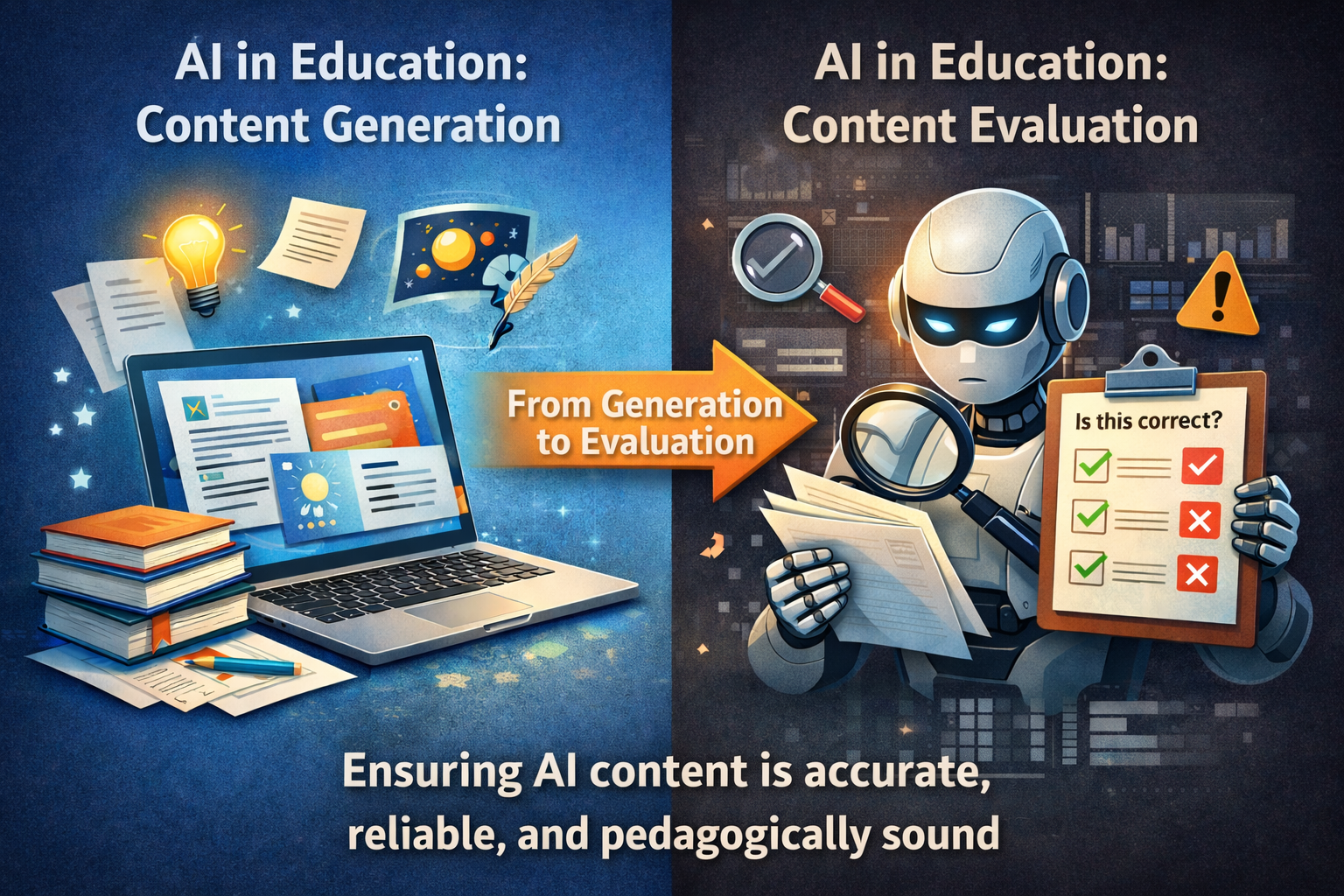
We are now living in an unprecedented moment of content abundance. With just a few prompts, it is possible to generate entire lesson plans, assignments, and feedback loops. What used to take hours or days can now be produced in minutes. At first glance, this appears to be a clear productivity gain. And in many ways, it is. But abundance introduces a new problem: when content becomes easy to produce, its value decreases unless its quality can be guaranteed. In other words, the bottleneck has moved. We are no longer constrained by how fast we can write. We are constrained by how well we can judge what has been written.
The Evaluation Problem
If generating content is now trivial, evaluating its correctness is anything but. Educational content is about accuracy, clarity, and pedagogical soundness. A slightly incorrect explanation, a misleading example, or an oversimplified concept can create misunderstandings that are difficult to correct later.
A natural idea emerges: if AI can generate content, why not use AI to evaluate it?
This is an appealing direction. In theory, it would create a self-reinforcing loop: AI generates, AI evaluates, AI improves. However, recent research suggests that this path is not yet reliable. For instance, Estévez-Ayres et al. (2024) evaluated LLMs such as ChatGPT in the context of a concurrent programming course. Their findings show that while LLMs can identify some errors and provide feedback, their agreement with human evaluators is only partial, and their performance drops significantly when complex issues such as race conditions and deadlocks are present. The authors conclude that LLMs can assist instructors but cannot replace them in providing high-quality feedback. Similarly, Seo et al. (2025) investigated LLMs as evaluators, focusing on the consistency and accuracy of their feedback. Their results highlight variability in judgments and limitations in reliably assessing correctness, raising concerns about the use of LLMs as standalone evaluators in educational settings.
Evaluation, it turns out, is a harder problem than generation.
Iteration as the New Default
In practice, working with AI-generated content rarely follows a linear path.
- Generate content
- Review it
- Correct it
- Regenerate parts of it
- Review again
Often multiple times. What initially feels like acceleration becomes a different kind of work: less time spent writing from scratch, more time spent refining and validating. This iterative process reveals something important: AI does not eliminate effort—it redistributes it. We move from creation to curation, from writing to judging.
Why AI Struggles with Evaluation
There is a deeper reason why evaluation is difficult for LLMs.
Generation is fundamentally about producing plausible continuations. Evaluation, on the other hand, requires:
- detecting subtle errors
- understanding context deeply
- applying domain-specific knowledge
- distinguishing between “sounds right” and “is right”
These are not just linguistic tasks—they are epistemic ones. LLMs are trained to optimize for plausibility, not truth. As a result, they can produce outputs that appear correct while containing inaccuracies, making self-evaluation particularly challenging. This limitation is especially visible in technical domains, as highlighted by Estévez-Ayres et al. (2024), where nuanced reasoning is required.
The Return of the Human-in-the-Loop
Paradoxically, the rise of AI has not reduced the importance of human expertise—it has amplified it.
Before AI, the typical learning workflow was:
Study → Apply
Now, it is often:
Apply → Study → Correct
We generate first, then verify.
This inversion changes the role of the human.
- a validator
- a critic
- a curator of quality
And this role is not optional. As Seo et al. (2025) emphasize, inconsistencies in LLM-generated evaluations make human oversight essential to ensure reliability.
Quality as the New Scarcity
We are entering a phase where the scarce resource is trustworthy content. AI enables scale, but scale without validation leads to noise. This has profound implications for education. The role of educators shifts from delivering content to ensuring its quality and relevance. In this context, expertise becomes more valuable, not less. The more content we can generate, the more we need people who can recognize what is worth keeping.
Rethinking Productivity
It is tempting to frame AI as a straightforward productivity enhancer. But if productivity is defined as the time required to produce validated, high-quality output, the picture becomes more complex. AI accelerates drafting, but evaluation introduces friction.
The real shift is not in doing less work, but in doing different work:
- less writing from scratch
- more reviewing and refining
Toward a Hybrid Model
The most realistic path forward is a hybrid model:
- AI for generation and initial feedback
- Humans for validation and final judgment
This “human-in-the-loop” paradigm is supported by current empirical evidence (Estévez-Ayres et al., 2024; Seo et al., 2025), which consistently shows that LLMs are not yet reliable enough to function as autonomous evaluators.
Rather than replacing educators, AI augments their workflow while preserving the central role of human judgment.
Conclusion: From Speed to Judgment
The story of AI in education is no longer about how fast we can create content. It is about how well we can trust it. We have largely addressed the problem of generation. We are now confronting the harder challenge of validation. And in this transition, human expertise becomes even more critical.
Because in a world where everything can be written instantly, the real skill is knowing what deserves to be trusted.
References
- Estévez-Ayres, I., Callejo, P., Hombrados-Herrera, M. Á., Alario-Hoyos, C., & Delgado Kloos, C. (2024). Evaluation of LLM tools for feedback generation in a course on concurrent programming. International Journal of Artificial Intelligence in Education.
https://doi.org/10.1007/s40593-024-00406-0 - Seo, H., Hwang, T., Jung, J., Kang, H., Namgoong, H., Lee, Y., & Jung, S. (2025). Large Language Models as Evaluators in Education: Verification of Feedback Consistency and Accuracy. Applied Sciences, 15(2), 671. https://doi.org/10.3390/app15020671