
Insiders and Outsiders in Science: A Framework Distinguishing Investigating and Investigated Countries in International Research Collaboration
As science becomes increasingly oriented toward solving real-world challenges – from poverty and disease to climate change and food insecurity – the relationship between researchers and the communities they study matters more than ever.
In our recent study, we propose a new framework for understanding international research collaboration through the lens of what sociologist Robert Merton called “insiders” and “outsiders”. By examining more than 112,000 scientific papers related to the United Nations Sustainable Development Goal of ending poverty, we explore how different research perspectives shape scientific agendas, visibility, and impact.
 The results reveal a changing global landscape of knowledge production, and raise important questions about whose voices are heard when science seeks solutions to local problems.
Core Framework: Five Ways of Seeing a Problem
Merton’s insider–outsider theory poses a classic dilemma: Must you be one to understand one? Insiders bring contextual familiarity, lived experience, and practical insight. Outsiders offer critical distance, generalizable frameworks, and the ability to see what insiders might take for granted.
Applied to geographically situated research, this becomes a concrete operational distinction. We define insiders as authors affiliated with the country (or region) under study, and outsiders as authors from elsewhere. By comparing the set of investigating countries with the set of investigated countries, we identify five collaboration patterns (Figure 1):
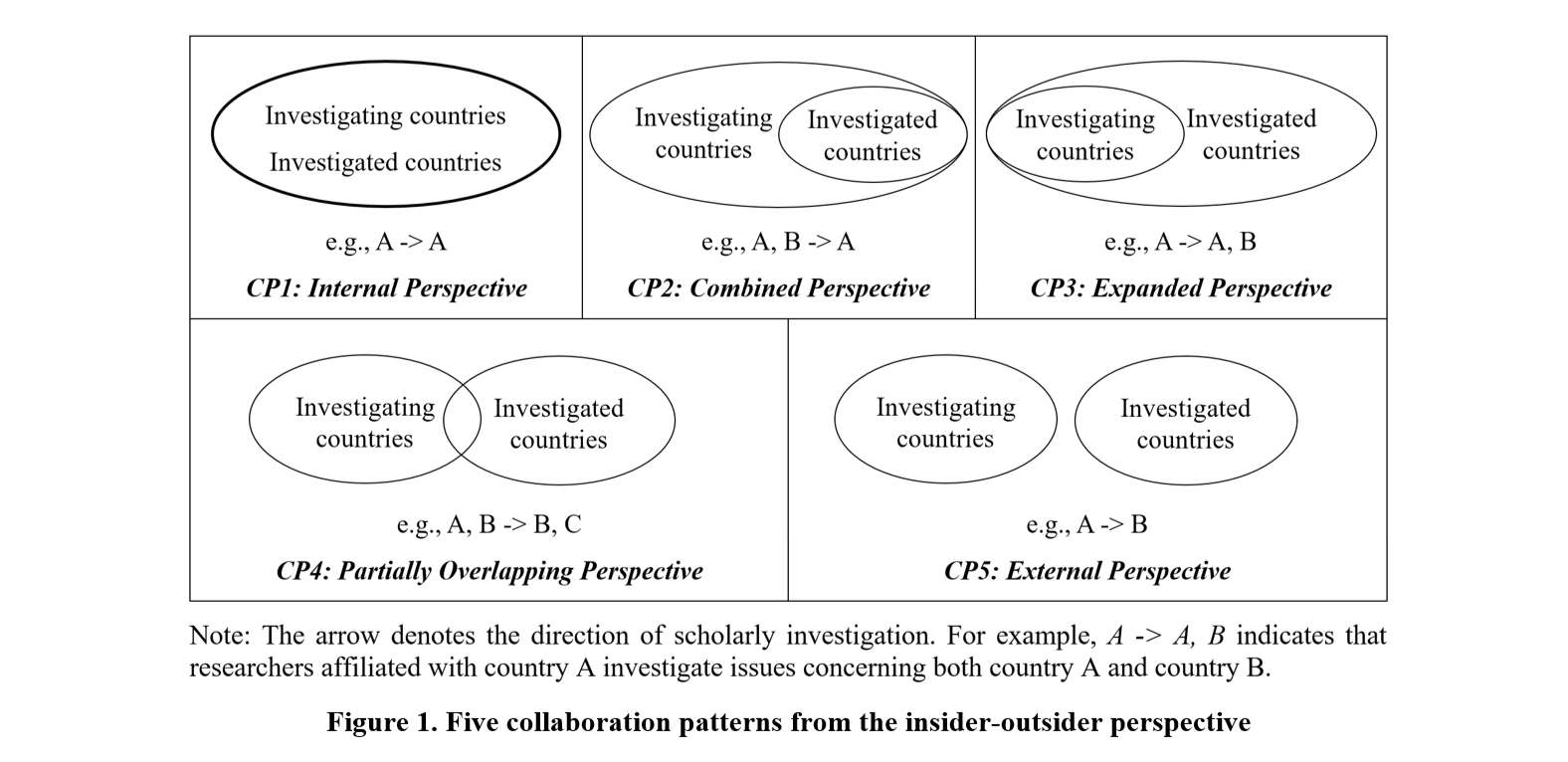
- CP1 – Internal Perspective: Authors study their own country. (e.g., South African researchers studying poverty in South Africa.)
- CP2 – Combined Perspective: Domestic researchers collaborate with international partners to study domestic issues. (e.g., South African + UK researchers studying South African poverty.)
- CP3 – Expanded Perspective: Researchers study a broader set of countries that includes their own. (e.g., South African researchers studying poverty in multiple African nations.)
- CP4 – Partially Overlapping Perspective: The sets of investigating and investigated countries overlap but neither contains the other.
- CP5 – External Perspective: Authors study countries entirely different from their own. (e.g., UK researchers alone studying poverty in South Africa.)
This typology moves beyond simplistic Global North–South binaries. It recognises that collaboration can be a spectrum, from purely internal work through genuine co-creation to purely external observation. Crucially, it allows us to ask: Which patterns dominate? How are they changing? What do they mean for the knowledge we produce?
What the Data Tell Us: From Global Patterns to Local Realities
We applied our framework to over 112,000 research papers on poverty (SDG 1), published between 1900 and 2024. The analysis proceeded in three steps: first, mapping the overall landscape of collaboration patterns; second, comparing their thematic and impact profiles; and third, zooming into Africa, where poverty research is most urgently needed.
(1) Five patterns – who studies whom?
Overall, the most common pattern is the Internal Perspective (CP1), accounting for 51.5% of all papers. These are studies where researchers examine poverty in their own country. The External Perspective (CP5, outsiders alone) follows with 23.1%, and the Combined Perspective (CP2, insiders and outsiders together) with 18.2%. The remaining two patterns – Expanded (CP3) and Partially Overlapping (CP4) – are relatively rare.
But the temporal trends tell a more dynamic story. Over the past two decades, the share of purely external research (CP5) has steadily declined, from 31.4% in 2000 to 16.5% in 2023. Meanwhile, collaborative insider–outsider research (CP2) has more than doubled, from 7.6% to 22.2%. Internal research (CP1) has remained remarkably stable. This shift suggests that global science is moving away from “parachute” studies and toward more integrated partnerships – at least in poverty research.
(2) Does the pattern matter for research outcomes?
Thematic focus: Papers that involve outsiders (CP2, CP4, CP5) tend to address more cutting‑edge topics than purely internal studies. However, internal studies (CP1) show the highest topic diversity over time – meaning insiders explore a wider range of poverty-related issues, even if those topics are less fashionable.
Impact: Both CP2 (combined) and CP5 (external) papers achieve substantially higher citation impact and reach more diverse audiences compared to CP1. In other words, research that includes outsiders travels further and is seen by more people worldwide.
(3) Deep dive – who studies poverty in Africa?
Africa remains the epicentre of global poverty, yet research on Africa has historically been led by outsiders. Our data cover nearly 20,000 papers focused on African countries.
Who are the insiders and outsiders? We defined insiders as authors from within a specific African region (e.g., Eastern Africa), and outsiders as all others. Across all five African regions, the United States and the United Kingdom are the dominant outsiders. France also plays a notable role in Northern and Central Africa.
To what extent do outsiders engage insiders? Unlike the global sample, purely internal research (CP1) is scarce in Africa – only about 40% of papers. The majority involve outsiders, either alone (CP5) or in collaboration with insiders (CP2). Over time, CP5 has declined and CP2 has risen, mirroring the global trend but with an even stronger reliance on external partners. In Eastern and Central Africa, external involvement exceeds 60%.
What do outsiders bring – and what might they displace?
Benefits: Papers with outsider involvement (especially CP2) have higher citation impact and broader audience reach than internal-only studies. Funding from the UK, US, and European agencies is the main engine behind this research. Topics such as health services, neonatal care, and climate change feature prominently – areas that align with international donor priorities.
Tensions: Insiders are more likely to study finance, industry, and local political histories (e.g., democracy, colonialism). When outsiders lead the partnership – which happens in more than half of CP2 papers (only 46% have an African corresponding author) – the research agenda may shift toward globally visible topics at the expense of locally rooted questions.
Funding patterns reinforce this asymmetry. Indigenous African funders mainly support CP1 research. By contrast, UK agencies like DFID and Wellcome Trust, US agencies like USAID and NIH, and European bodies direct a large share of their poverty research funding to Africa – but predominantly to studies involving outsiders.
The bottom line: Outsiders bring resources and visibility, which are desperately needed. But without deliberate efforts to ensure local leadership and locally defined priorities, even well-intended collaboration can subtly erode the voice of those who live with the problem every day.
Conclusion: Toward Rooted, Not Parachute, Science
Our framework is not a critique of international collaboration. It is a call for reflexive collaboration – partnerships that are aware of whose perspective is shaping the research question, whose priorities are funded, and whose voice leads the writing.
The rise of CP2 (combined perspective) is a genuine advance. It suggests that the days of purely external researchers studying Africa without African colleagues are declining. But behind the aggregate numbers lies a more ambiguous reality. In our dataset, only 46% of CP2 papers on Africa list an African author as the corresponding author – a rough proxy for intellectual leadership. In half of these partnerships, the outsider still steers the ship.
This matters because research shapes not only what we know, but what we consider worth knowing. If international collaboration systematically shifts local research agendas toward externally defined priorities – health rather than finance, climate rather than industry – then even well-intended partnerships can subtly erode local discourse authority.
The way forward is not to close borders, but to balance them. Outsiders bring resources and reach. Insiders bring relevance and rootedness. The most powerful science happens when both perspectives are not merely present, but genuinely integrated—when the question itself is co-owned.
As one African proverb puts it: “If you want to go fast, go alone. If you want to go far, go together.” But going far together means deciding together where you are heading. Our framework offers a simple but powerful tool for asking that question – paper by paper, partnership by partnership.