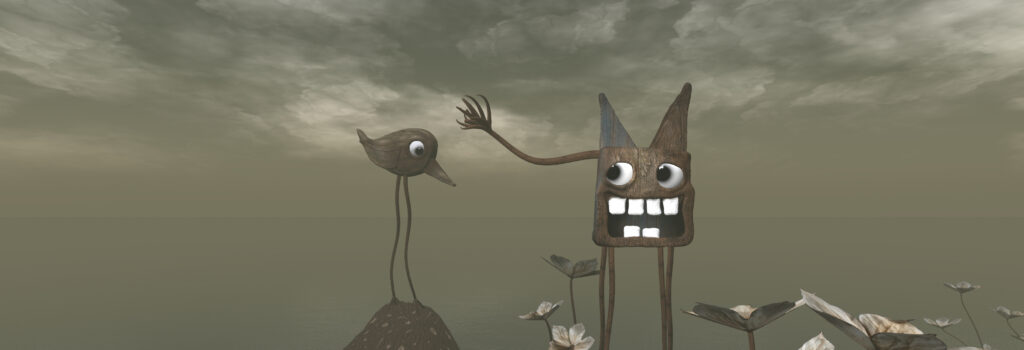
Installation in Second Life by artist Cica Ghost, photo by Sheila Webber
You know that polycrisis isn’t just an academic obsession when the accountants start saying it’s a thing. In a document that mentions polycrisis 84 times, the Chartered Institute of Management Accountants (CIMA) identifies that understanding “the interconnectedness of external factors such as climate change, nature, or inequality, and seeing the patterns of change and the feedback loops between the factors” is essential for developing a sustainable business model. This obviously intersects with Lawrence et al.’s (2024) definition of polycrisis as “the causal entanglement of crises in multiple global systems in ways that significantly degrade humanity’s prospects.” CIMA advocates developing people’s literacy in polycrisis concepts: polycrisis literacy.
—Why information literacy rather than polycrisis literacy, digital literacy, media literacy, AI literacy (or substitute any literacy of your choice)?—
However, I propose that what is really needed is information literacy. Why information literacy rather than polycrisis literacy, digital literacy, media literacy, AI literacy (or substitute any literacy of your choice)? This is because a crisis doesn’t involve just one type of information. Take health as one example. Vaccine hesitancy is influenced by literacy in understanding oral and written information. How HIV/AIDS and ebola are handled is impacted by beliefs, myths and customs, including information given by leaders in the local community (Wella & Webber, 2018; Muzembo et al. 2020; WHO, 2026). People learn about illness and disease by observing their own, and other people’s bodies (Godbolt, 2013; Oliphant et al., 2022). During COVID, local information (gained through observing what was happening on the street and just talking to people) was important. We also have to remember that not all cultures are obsessed by written text. This chimes with Brookes’ (1974) statement that “life is a continuous information process in which physical, genetic, sensory, and cognitive components all act together” and Bates’ multilayered model of information. UNESCO’s championship of Media and Information Literacy (MIL) has been vital in mobilising international engagement, sponsoring initiatives in the Global South and developing valuable resources such as the MIL curriculum. However, there is a lot more emphasis on media than on information in these endeavors. We cannot just wait for UNESCO to sort things out. So how can we work with information literacy in a polycrisis, in ways that don’t “significantly degrade humanity’s prospects”?
We can continue to reflect on, research, co-create, discuss and disseminate the meaning of information literacy in our changing world. This does not mean knee-jerk reformulations of information literacy in reaction to the latest technological development. It means ongoing, proactive exploration of information literacy in different contexts, recognising nuance and difference, so that that when we talk to people about information literacy it connects with their specific context and life.
We can be assertive and persuasive in arguing the value and relevance of information literacy. It is not a matter of being overawed by our own discipline, but of recognising its value and being willing to be robust. Information literacy is not a magic solution. However, developing people’s situational awareness of, and engagement with, the various forms of information in their lives can contribute to living life in the best way you can.
We can identify collaborators, some of whom may already be practising or researching information literacy without calling it that. Following on from my previous point, it is OK to say “Oh, so you’re researching information literacy too, that’s my discipline! Let’s work together”. These conversations can be challenging, particularly with people who are not accustomed to looking outside their own discipline, or who are used to patronising librarians, but some will respond positively. Information literacy experts can draw on information research that may provide alternative perspectives on 21st century challenges. There can also be closer collaboration nearer to home: between researchers in information literacy, information behaviour and information experience; between researchers and practitioners; between information researchers in different geographical regions.
We can practise, and develop in others, healthful hesitancy in technology adoption, particularly in adoption of AI, the “valuable tool that requires vigilance”. We can explore what it means to be information literate in our use of AI and appreciate where it can bring genuine benefits. We can also be be robust and evidence-based in pushing back against ill-thought-through AI adoption.
This brings in the importance of developing information literate organisations, which have embedded information literacy into their operational structure and corporate culture. This includes engaging critically and ethically with the information that flows to, from, and around the organisation.
To reiterate: information literacy does not provide a magic solution. However, it has an important contribution to make in a time when the world seems to need all the help it can get.
Cite this article in APA as: Webber, S. (2026, June 17). Information literacy in a time of polycrisis. Information Matters. https://informationmatters.org/2026/06/information-literacy-in-a-time-of-polycrisis/
Sheila Webber is a faculty member in the School of Information, Journalism & Communication, University of Sheffield, UK. Her focus is on Information Literacy and Information Behaviour. She is an Honorary Fellow of CILIP and recipient of the Jason Farradane award for services to Information Science. Sheila is a member of UNESCO's Media and Information Literacy Alliance, and has served as Chair of ASIS&T European Chapter and as a member of the IFLA Information Literacy Section committee. She has blogged information literacy at http://information-literacy.blogspot.com since 2005.