Taiwanese Disease, Formosan Flu: Central Bank as Information Gatekeeper
 Burgernomics and boundary objects
The Big Mac Index itself is an intriguing entry point: created by The Economist in 1986, it was originally a lighthearted way to measure purchasing power parity by comparing the cost of an identical McDonald’s Big Mac across countries. As Investopedia notes, while the index is not a precise economic tool, it functions as a globally recognisable proxy for relative currency value because a Big Mac is always a Big Mac.
In science and technology studies, Star and Griesemer’s boundary object (1989) refers to entities that are flexible enough to be interpreted differently across social worlds but consistent enough to maintain identity. The Big Mac in this sense becomes a boundary object straddling economic theory, public discourse and also political narrative. It translates multiplex macroeconomic ideas into something legible and portable. The metaphor of a burger (humble and global) allows The Economist to sneak an otherwise dry observation about exchange rates into the broader marketplace of ideas.
Information infrastructure and central banking
Bruno Latour’s actor‑network theory (ANT, 2005) teaches that objects and institutions are backdrops and also participants in networks of meaning and practice. The central bank, then, is not a neutral conveyor belt for money here but an infrastructure node that shapes signal flows. Geoffrey Bowker’s work on infrastructure (1994) also insists that infrastructures are technical and also epistemic frameworks that determine what counts as legible, what remains mute and how knowledge circulates.
Under this lens, Taiwan’s central bank becomes a curator of macroeconomic information: it privileges export competitiveness as a high‑bandwidth signal to global investors while dimming the domestic signals of weakened purchasing power and rising asset prices. Unlike a laboratory thermometer that simply reports temperature, the central bank as information gatekeeper chooses which macro signals are amplified and which are suppressed.
In a classic information theory move, we might think in terms of Claude Shannon’s signal‑to‑noise ratio (1948) here. Under the current regime, signals related to export success and trade surpluses are broadcast loudly, while domestic signals (stagnant wages, housing stress, everyday cost burdens….) are lower amplitude and easily drowned out. It is not that those signals do not exist; it is that the infrastructure of monetary policy makes them harder to perceive and act upon.
Purchasing power and the infosphere
Luciano Floridi’s notion of the infosphere (2014) invites us to treat informational environments as ecological: goods, services and prices are nodes in a dense web of signals. If purchasing power weakens, that is not simply a matter of economic measurement but a degradation of the informational environment through which people perceive economic reality.
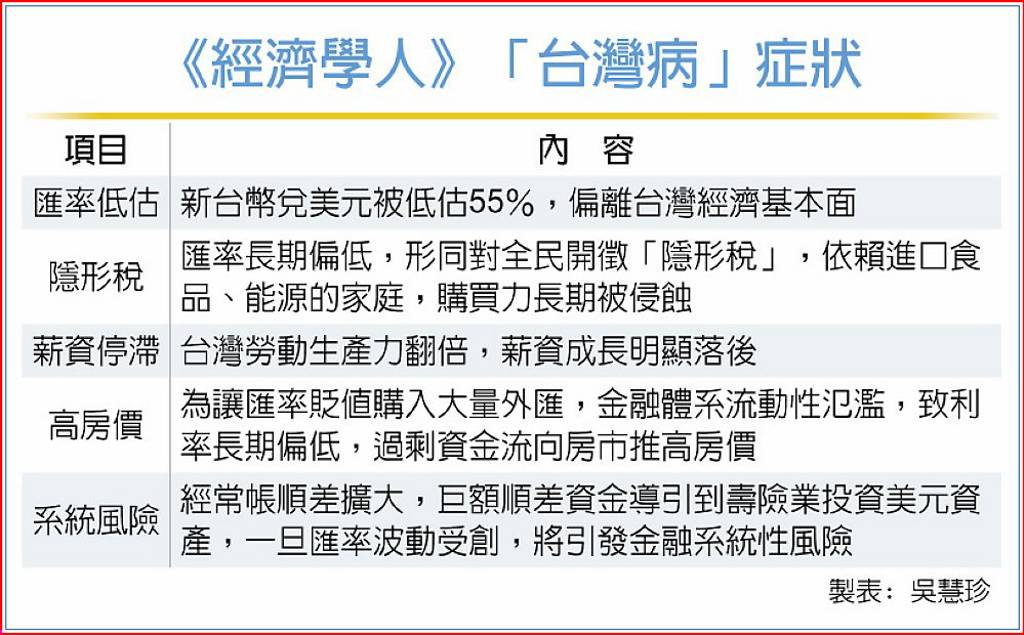
In Taiwan’s case, the Big Mac Index suggests that the New Taiwan dollar is cheap in exchange rate terms and in the constellation of signals that inform citizens about their economic standing. Consumers may feel the pinch in rent or grocery bills even if official inflation numbers remain subdued. Such experiential “information deficits” have real consequences on welfare and behaviour, even if they do not always register in headline macro statistics.
Housing as high‑bandwidth asset storage
If we extend this metaphor, the housing market becomes a high‑bandwidth repository of distorted signals. Cheap money and weak currency policies create what many observers have dubbed “housing slaves”: young adults burdened by property costs that have soared relative to income. Taipei’s median house price to income ratio is notoriously high by regional standards, a fact that is reflected in The Economist’s broader narrative about domestic strain. Here I want to call upon Sara Ahmed’s notion of affective economies (2004), where economic signals are not abstract numbers but charged with emotional valence: house prices and purchasing power are not neutral lines on a chart but affective data points that shape life decisions, belonging and aspiration.
Governmentality and macro signaling
Michel Foucault’s concept of governmentality (1991) illuminates how central banking governs through rates and reserves and also through shaping the architecture of economic legibility: the central bank, in this light, does more than adjust policy instruments; it orchestrates which narratives are amplified and which recede into the background. By prioritising trade surplus stability and export competitiveness, it cultivates an interpretation of economic health that resonates with global capital flows while domestic purchasing power becomes a quieter, harder-to-discern signal.
The Big Mac Index, often dismissed as a playful heuristic, in fact performs quite a critical function here. Its persistent signals (showing the New Taiwan dollar’s undervaluation) quietly corroborate concerns about the domestic costs of these policies. Even if central bankers and some economists caution against reading too much into a single measure, the fact that such a simple, tangible index aligns with lived experience and price pressures suggests that The Economist’s “Taiwan disease” observation is sensationalist and simultaneously legible through the very patterns of everyday consumption. In this way, information circulates in spreadsheets and through bite-sized, globally comparable signals that reveal consequences otherwise rendered invisible.
Toward rebalancing the infosphere…?
What would it mean to treat the signals of purchasing power, wage stagnation and asset inflation not as noise to be suppressed but as data streams worthy of amplification? Perhaps it would mean developing alternative boundary objects that better capture domestic economic experience or it might require more refined informational scaffolding that do not so heavily privilege export metrics over everyday life. Geoffrey Bowker reminds us that the categories and classifications we choose have political and ethical consequences.
Taiwan’s “Formosan flu” (whether metaphorical or material) is thus a matter of economic pathology and also an information problem. The central bank as information gatekeeper may steer signals toward some audiences but in doing so it also shapes who sees what, who feels what and who gets heard and in the end, the illness of an economy may be less about the numbers and more about the stories those numbers are allowed to tell.