MemGPT: Engineering Semantic Memory through Adaptive Retention and Context Summarization
How MemGPT’s Memory Architecture Functions
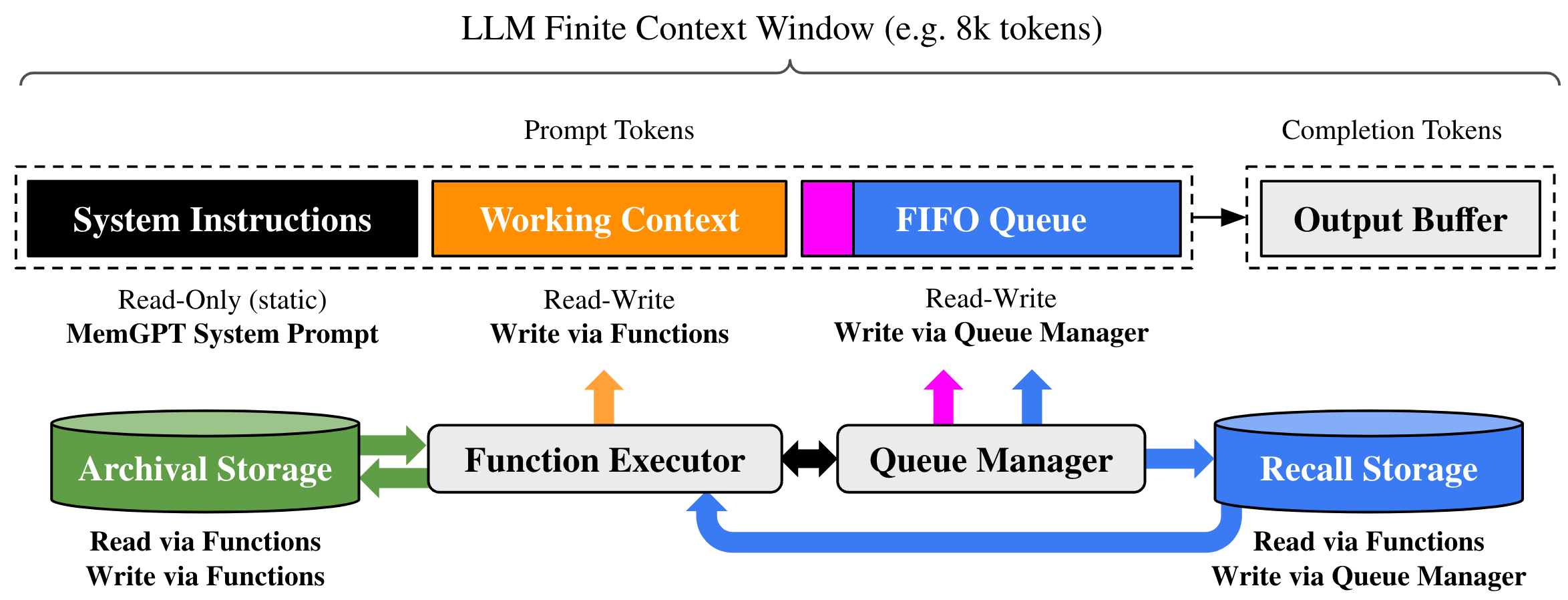
MemGPT’s revolutionary approach lies in its virtual context management system, which creates a sophisticated memory hierarchy reminiscent of computer architecture. The system divides memory into distinct tiers: main context (analogous to RAM) and external context (similar to disk storage) . The main context contains the AI’s immediate working space, constrained by the underlying LLM’s token limits, while the external context serves as a massive, searchable archive of past interactions.
This multi-level memory architecture consists of several specialized components working in concert:
- Core Memory: An always-accessible compressed representation of essential facts and personal information
- Recall Memory: A searchable database enabling reconstruction of specific memories through semantic search
- Archival Memory: Long-term storage for important information that can be moved back into core or recall memory as needed
The system employs vector databases like LanceDB as the default archival storage, which allows MemGPT to perform sophisticated semantic searches across its entire memory space . When you ask a question, MemGPT doesn’t just search for keyword matches, it looks for conceptually related information from past interactions, regardless of the exact wording used previously.
What makes MemGPT particularly innovative is its use of the LLM itself as the memory manager. Through self-directed memory editing via tool calling, the system can actively manage its own memory contents, deciding what to store, what to summarize, and what to forget . This represents a significant departure from traditional AI systems where memory management was typically handled by separate, rule-based systems.
The Revolution of Strategic Forgetting
Perhaps the most counter-intuitive yet groundbreaking aspect of MemGPT’s design is its treatment of information forgetting not as a failure, but as an essential feature. In traditional information systems, preservation is paramount, deletion represents data loss. MemGPT challenges this paradigm by implementing strategic forgetting through two key mechanisms: summarization and targeted deletion.
This approach represents a fundamental shift in how we think about information management in AI systems. Where conventional retrieval-augmented generation (RAG) systems aim to maximize recall, MemGPT prioritizes precision and relevance. By strategically managing its memory footprint, MemGPT avoids what researchers call “context pollution“, the problem of too much irrelevant information clogging the limited context window and degrading performance.
MemGPT employs what might be called “cognitive triage” using the LLM itself to evaluate the potential future value of information fragments. Important user preferences, core facts about ongoing projects, and critical personal details receive higher priority for retention, while transient conversational elements and repetitive information are candidates for summarization or deletion. This dynamic evaluation allows MemGPT to maintain what feels like a coherent personality and contextual awareness across multiple interaction sessions, something that has remained elusive in previous AI systems.
From Episodic to Semantic Memory Transformation
The memory processes in MemGPT bear striking parallels to human memory systems, particularly in how we naturally transform episodic memories (specific experiences tied to times and places) into semantic memories (general knowledge detached from context). This transformation from episodic to semantic memory in humans involves complex cognitive processes that MemGPT replicates through its architecture.
When MemGPT encounters information across multiple contexts, it gradually decouples the core information from its specific contextual details, a process analogous to “semantization” in human cognition. For example, if a user repeatedly mentions preferring morning meetings, this preference might transition from being stored as a specific instance (“yesterday the user said they like mornings”) to a general semantic fact (“this user prefers morning meetings”).
This cognitive architecture enables what researchers call “self-directed editing and retrieval“; the AI can actively manage its own memory contents, much like humans consciously organize their thoughts and recollections. The system maintains what amounts to an inner monologue, constantly evaluating and reorganizing its knowledge base even when not actively engaged with users. This represents a significant step toward AI systems with more human-like continuous learning capabilities, as opposed to the static knowledge bases of traditional language models.
Real-World Applications and Implementation
The practical implications of MemGPT’s memory system extend far beyond more engaging chatbots. The technology enables persistent AI assistants that can build relationships with users over time, remembering their preferences, work habits, and personal details. In document analysis, MemGPT can maintain context across lengthy legal contracts or research papers, connecting concepts from the introduction to findings in the conclusion far beyond the underlying LLM’s context window.
The integration process demonstrates how straightforward implementing this advanced memory system can be. MemGPT is designed to be model and provider agnostic, supporting various LLM backends including OpenAI, Anthropic, Google Gemini, and local models through Ollama and llama.cpp. This flexibility has accelerated adoption across diverse domains, from customer service to research assistance.
One of MemGPT’s most powerful features is its ability to create and manage AI agents with distinct personas. This capability transforms MemGPT from a mere memory management system into a robust agentic framework. Developers can create agents with specific roles, knowledge bases, and behavioral traits, each initialized with a unique persona that guides its interactions and decision-making processes over time.
The Future of AI Memory Systems
Despite its groundbreaking capabilities, MemGPT represents just the beginning of AI memory systems. Current limitations include token budget constraints that still restrict how much information can remain simultaneously active. Researchers are exploring several avenues for improvement, including incorporating various memory tier technologies like databases and caches, optimizing memory allocation systems, and enhancing the model’s architecture.
The most promising future direction involves developing even more sophisticated memory hierarchies that better mirror human cognitive systems. Future iterations might include distinct episodic memory for specific events, semantic memory for general knowledge, and procedural memory for learned skills and adaptations. Such systems could enable AI not just to remember facts, but to reflect on past experiences and improve its performance over time moving from mere information retrieval to genuine cumulative learning.
As these memory architectures evolve, they raise important questions about the nature of intelligence and consciousness in artificial systems. The ability to maintain a continuous identity across interactions, to build upon past experiences, and to strategically manage one’s own knowledge base brings us closer to creating AI with genuinely human-like cognitive capacities. While we’re still in the early stages of this journey, MemGPT represents a crucial step forward bridging the gap between statistical pattern matching and contextual understanding, between reactive responses and proactive assistance, and ultimately, between artificial intelligence and authentic cognition.