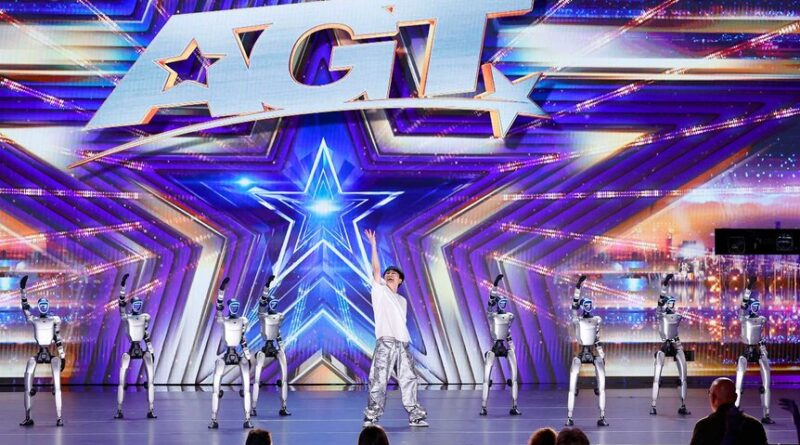
A stage that expands beyond the theatre
In information science, media theorists have long argued that technological artefacts gain meaning through circulation. Harold Innis (1951) suggested that communication systems shape how societies organise time and space, while Marshall McLuhan (1964) proposed that media themselves function as environments and not neutral channels. Seen through this lens, the America’s Got Talent stage becomes only one node in a much larger system of mediation.
Once uploaded, clipped and recombined across platforms, the performance shifts from broadcast event to networked artefact. José van Dijck (2013), writing on platform society, describes how digital infrastructures shape visibility through ranking, recommendation and filtering mechanisms. The robot performance enters this environment and becomes reorganised by algorithmic attention: what is most shareable, most surprising or most emotionally resonant rises to prominence.
This circulation matters because it changes what the performance is. It acquires new contexts as it moves, each shaped by platform logics and user interpretation. The original choreography remains fixed, yet its informational life expands and mutates.
Unitree’s Robots as symbolic objects
The machines themselves carry a dual identity: on stage, they are engineered systems designed for coordinated movement and in circulation, they become symbolic objects through which broader ideas about technological development are expressed.
Lucy Suchman’s work on human–machine interaction (2007) highlights how agency is distributed across sociotechnical systems, in lieu of residing solely within machines. The robots’ movements appear autonomous and expressive, yet they depend on layers of design, programming and synchronisation and their apparent fluidity masks an infrastructure of control and calibration.
At the same time, the public reception of Unitree’s robots extends beyond technical appreciation. They come to represent ideas about automation, labour and national technological capability and in media commentary, they are often positioned as indicators of industrial progress, particularly within narratives of global technological competition.
Shoshana Zuboff’s concept of surveillance capitalism (2019) offers a related perspective on how technological systems become lodged within wider economic and informational structures. While the robots themselves are not surveillance devices, their circulation within platform ecosystems links them to attention economies that extract value from engagement, reaction, visibility.
Through this lens, Unitree’s robots operate simultaneously as physical machines and as symbolic carriers of informational value.
Competing interpretations of a single performance
The same three-minute clip generates multiple interpretive frames depending on audience position.
For entertainment audiences, the performance appears as novelty and spectacle and the synchronisation between human dancer and robots produces a sense of surprise and aesthetic enjoyment. The emotional response often centres on amazement at technical precision and choreography.
Within robotics and engineering communities, attention tends to shift towards motion control, stability and system design. The performance becomes evidence of advances in humanoid robotics, particularly in balance algorithms, locomotion and real-time coordination.
In broader geopolitical discourse, the clip acquires different connotations. It is sometimes read as an illustration of national technological progress or industrial capability. These interpretations align with what media scholar Joseph Nye (2004) terms “soft power”, where cultural and technological outputs contribute to perceptions of influence and prestige.
Meanwhile, critical perspectives raise questions about automation, labour displacement and the increasing entanglement of entertainment with technological demonstration. These readings draw on broader debates in science and technology studies, including Donna Haraway’s “Cyborg Manifesto” (1985), which challenges the boundary between human and machine identities. What becomes clear is that the performance does not stabilise into a single meaning; instead, it functions as an interpretive surface onto which different futures are projected.
The robot stage as an imagination infrastructure
The concept of “infrastructure” in information science extends beyond physical systems to include the often invisible frameworks that enable perception and communication. Geoffrey Bowker and Susan Leigh Star (1999) describe infrastructures as relational and embedded, shaping action while remaining partially unseen.
The global circulation of Unitree’s robots can be understood as part of an imagination infrastructure. This infrastructure includes broadcast media, recommendation algorithms, social platforms, comment cultures and news amplification systems. Together they organise how technological futures are encountered and discussed. Within this system, the stage functions as an entry point and not a boundary. The performance initiates a chain of informational transformations: recording, clipping, captioning, reposting and commentary. Each step adds interpretive layers that shape how audiences understand what they are seeing.
The robots therefore participate in a distributed process of meaning-making: they are performing choreography and they are also in a system that produces narratives about technological possibility.
Why the performance feels like “the future”
The sensation that such performances reveal something about the future of intelligence is not accidental. It emerges from the interaction between novelty, visibility, cognitive expectation.
Brian Arthur’s work on technological evolution (2009) suggests that new technologies are often interpreted through existing cognitive frameworks until they accumulate enough familiarity to form new ones. Humanoid robots occupy a threshold space where recognition and unfamiliarity coexist. They resemble human performers yet remain visibly mechanical, producing a tension that invites projection.
Information science also emphasises the role of salience in perception. In Herbert Simon’s early formulation of attention economics (1971), attention becomes a scarce resource shaped by information abundance. The more unusual or emotionally striking an event appears, the more likely it is to dominate attention flows and the robot performance fits this condition precisely: it compresses engineering knottiness into a visually arresting sequence.
As a result, audiences are prompted to extrapolate beyond the immediate event and the robots become placeholders for broader questions about automation, creativity, intelligence.
Emotional economies of technological imagination
Reactions to the performance reveal that technological interpretation is very emotional. Enthusiasm, anxiety, pride and curiosity circulate alongside technical assessment.
Media theorist Tiziana Terranova (2004) describes digital culture as operating through “free labour”, where users contribute affective and interpretive energy to platforms. In this case, viewers generate vast amounts of emotional commentary that further amplifies the visibility of the clip. These emotional responses also shape geopolitical readings. For some viewers, the performance signals progress and innovation. For others, it raises concerns about technological acceleration and competition. The same visual sequence becomes a site where hope and unease coexist.
This emotional layering contributes to what might be called a collective technological imagination. Futures are predicted through data or expertise and they are also felt, shared, circulated through media engagement.
Ownership of a circulating future
The Unitree performance offers an example of how technological artefacts move through global information systems and acquire layered meanings. The robots remain physically located on a stage, yet their informational presence extends across platforms, communities and interpretive contexts. Questions of ownership become knotty within this environment: Unitree may own the hardware design, broadcasters may own the footage and platforms may control circulation; however, the interpretive life of the performance spreads beyond these boundaries. It is shaped by millions of micro-interactions: comments, reposts, edits, reactions.
Bruno Latour’s actor-network theory (2005) provides a useful lens here, suggesting that agency is distributed across networks of human and non-human actors. The robots, the dancer, the audience, the recording devices and the platform algorithms collectively produce the event as it is experienced globally.
In this sense, Unitree’s robots travel through more than physical space.
They move through informational structures that organise attention and imagination, and the futures they appear to suggest are generated through the systems that carry it.