From Keyword to Conversation: What LLMs Change (and Don’t) About Library Discovery in Ghana’s Colleges of Education
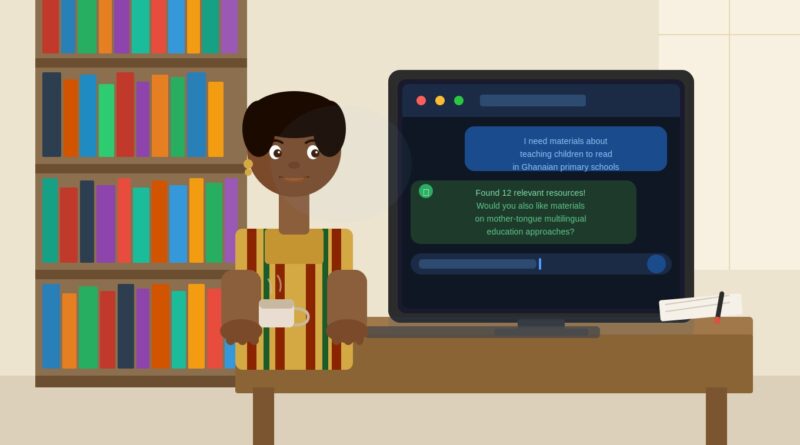
Large language models offer something genuinely new to library users: the ability to search in natural, conversational language rather than having to translate their information need into the controlled vocabulary of a catalogue. In Ghanaian Colleges of Education, where student-teachers come from communities that speak Twi, Ewe, Dagbani, Ga, and dozens of other languages, this matters more than it might first appear. For students navigating a library system built largely in English, around English-language cataloguing conventions, the gap between what they are looking for and what the system can find has always been wide. A conversational interface that aligns more closely with users’ own language and framing, even partially, is a meaningful step toward more equitable access.
The iterative, dialogic quality of LLM-powered discovery is also promising for the kinds of research student-teachers do. Lesson planning, curriculum development, and educational research rarely begin with a precise, well-formed query. They begin with a question, a topic, or a classroom problem. An interface that allows users to explore, refine, and follow threads — rather than requiring a well-structured search string from the outset aligns more naturally with how learning actually works. For a student who is simultaneously becoming a teacher and learning to use a library, that lower threshold matters.
 And yet the collections themselves have not changed. In many Ghanaian CoE libraries, holdings are limited, cataloguing records are incomplete or inconsistent, and digital resources remain thin. The metadata that LLMs depend on to surface relevant materials reflects decades of collection development shaped by availability, budget constraints, and inherited descriptive frameworks that were not designed with the Ghanaian curriculum or Ghanaian educational contexts in mind. A fluent, helpful-sounding AI response cannot conjure materials that the collection does not hold. Worse, it may give a student the impression that a thorough search has been done — that the confident, well-phrased response represents the full picture, when in reality, whole areas of relevant knowledge simply do not appear because they were never described in a way the system can find.
The unglamorous work of improving how collections are described, adding local subject terms, correcting inconsistencies, documenting gaps, becomes more consequential, not less, as AI interfaces become more capable. This places the college librarian’s work in a new light. The unglamorous work of improving how collections are described — adding local subject terms, correcting inconsistencies, documenting what the library does not have — becomes more consequential, not less, as AI interfaces become more capable. If the model’s output is only as good as the description that feeds it, then the librarian who insists on careful, culturally grounded cataloguing is directly shaping whether AI-assisted discovery works for Ghanaian students or merely works around them. In resource-constrained institutions, where one librarian may manage an entire collection, this is a real and weighty responsibility.
There is also a question of infrastructure. LLM-powered discovery tools assume reliable internet connectivity, updated hardware, and institutional access to platforms that carry significant licensing costs. These are not givens in Ghana’s Colleges of Education. Any serious conversation about AI and library discovery in this context must grapple honestly with those constraints, not to dismiss the technology’s potential, but to ensure that enthusiasm for new tools does not outpace the material conditions required to make them work.
The shift from keyword to conversation is real, and its promise for students in contexts like ours is worth taking seriously. But the promise is only as good as what lies beneath the interface: the collection, the description, the connectivity, and the librarian’s professional judgment in maintaining it. In Ghana’s Colleges of Education, that foundation is being built, often with limited resources and considerable creativity. AI-assisted discovery can be a genuine aid in that work, but only if we are clear-eyed about what it can and cannot do on its own.